Categories
Blog

At Long Last Osceola

More than four years have elapsed since I began collaborating with Patrick Bowen on the transcription, annotation, and biographical sketches for Letters to the Sage. But only last week did I finally get to Osceola, Missouri where Thomas Moore Johnson, Sage of the Osage, was born and spent most of his life. This visit followed the biennial convention of the Church of Light in Albuquerque, where a three hour preconference was devoted to Johnson and his correspondents. That presentation will be the source of several future updates to this blog. After the conference and before the visit to Osceola, I was able to meet Patrick Bowen at last after four years of collaboration, while visiting friends in Colorado.

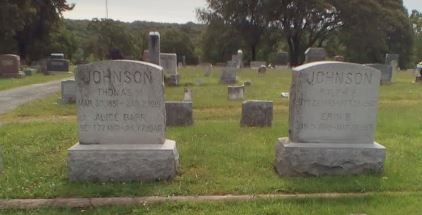
I am very grateful to Mary Ann Johnson Arnett, a great-granddaughter of Thomas Moore Johnson, and her husband Jim Arnett for welcoming me to their Kansas home where they have collected memorabilia of the Johnson family and St. Clair County that whetted my appetite for the next day’s visit to Osceola. Before visiting the Johnson Library and Museum, the Arnetts took me to the St. Clair County Historical Society Museum just off the quaint town square. Welcoming us to the museum was Osceola resident and author Meredith Anderson, who with his wife Linda has written more than a dozen books many of which focus on 19th century Missouri. Downstairs exhibit space is broken up into several rooms, one of which is devoted to the Johnson family of Osceola, which include the wedding dress of Alice Barr Johnson, wife of TMJ, and a top hat that he wore. The upstairs of the former church building contains a large meeting hall, and the picture above shows Jim Arnett in the meeting hall. On the way to the Johnson Library and Museum, we stopped at the cemetery where Thomas and Alice Johnson are buried, next to the gravesite of their son and his wife.

We then proceeded to the Johnson Library and Museum which overlooks the former Osage River which is now a branch of Truman Lake. I have previously posted a YouTube video of Tom Johnson’s tour of the building, but having him lead me through the buildings in person was a great honor and a memory I will keep the rest of my life. At the end of the tour we all had an unexpected surprise from Larry Lewis, whose collateral ancestor Edwin Lewis is mentioned in the Letters as the only Osceola friend of TMJ to follow him into both the Theosophical Society and the Hermetic Brotherhood of Luxor. Larry is author of a new history of Osceola, and just that morning he had learned by email that his book had been nominated to the State Historical Society of Missouri for best book of the year on Missouri history. I have just gotten back home and not yet begun the book, but Larry pointed out to me on page 90 he mentions Letters to the Sage, names Patrick and me as coeditors, and gives publishing information. This is a big milestone for us, the first new book in which LTS is mentioned. I would have expected it to be in some academic tome but being mentioned in a book about Osceola from someone intimately acquainted with the TM Johnson descendants is ten times more gratifying. Before heading back home I enjoyed lunch with Larry and his wife Ruth and the Arnetts within sight of Osceola’s town square, and learned even more about the town’s history. Here is a review of the new book.

Part 2: after arriving back in Virginia I read Larry Lewis’s book and added the following remarks:

Any small county seat would be fortunate to have its stories told by a native with Mr. Lewis’s qualifications. A descendant of the earliest settlers of St. Clair County, he spent ten years of childhood there before being relocated by his father’s wartime employment in Connecticut, and then spent most of his adult life elsewhere. Returning for good after retirement from the Episcopal ministry in 1997, he has been involved in many aspects of town life, including becoming a founding board member of the Johnson Library and Museum established in 1999. His accounts combine the nostalgic glow of family memories and objective description of disasters and decline following the 1861 burning of the town by Kansas Jayhawks and the creation of Truman Lake in the 1970s which ruined what had once been a lively waterfront district on the Osage River.

Chapter 6, “Emily’s Cat,” opens with a description of his first cousin Emily Johnson’s pet Iamblichius, a name with which Lewis was unfamiliar until decades later when he developed an interest in her grandfather Thomas Moore Johnson. Although TMJ was long gone by the time Larry arrived on the scene, “Miz Moore Johnson,” his widow Alice, survived until 1948 and is fondly remembered to this day. The chapter focuses largely on the life and work of TMJ, and includes a description of the varied scholars and writers who have taken an interest in him in recent years. These passages are excerpted from pages 89 and 90:

Word about Thomas Moore Johnson is getting around. Scholars on the east and west coasts and parts between are seeking information with a view to writing about the mystical phase of Johnson’s thinking. The scholar K. Paul Johnson in Virginia has documented Moore Johnson’s 1880s relation to the Hermetic Brotherhood of Luxor [in this blog-KPJ]…Far to the west, in southern California, poet and musician Ronnie Pontiac published a novella-length study of Thomas M. Johnson in the March 19, 2013 issue of Newtopia Magazine…Johnson is cast as a hero in an article by Patrick D. Bowen published the following year…for the journal Theosophical History…Here’s the opening sentence of Bowen’s conclusion: “This article has, hopefully, demonstrated that a number of key developments in American esotericism can be traced to Missouri in the 1880s and that Thomas M. Johnson was a key player in all of these.” Classicist Jay Bregman at the University of Maine, a specialist in the influence of Neoplatonism on the thought of New England Transcendentalism and its offshoots, in his article “Thomas M. Johnson the Platonist” explains the attraction of devotees of the esoteric for Johnson and his Neoplatonist friends…across the Atlantic in Great Britain..the Prometheus Trust published in 2015 the Collected Works of Thomas M. Johnson, the Great American Platonist…Near the beginning of 2016, Patrick Bowen and K. Paul Johnson published Letters to the Sage

In his book published later in 2016, Mr. Lewis brings the unique perspective of an Osceola resident with family lies to the Johnsons to his own work which combines memoir, Civil War history, ecological commentary, and thoughts about the present and future of his home town. I highly recommend the book to anyone who has taken an interest in Thomas Moore Johnson.

Categories
Blog

Hermeticism in Expect Great Things by Kevin Dann


A new study of Henry David Thoreau sheds more light on the Hermetic underpinnings of Transcendentalism. In Expect Great Things, Kevin Dann notes that the figure in the Concord milieu most influential in promoting Hermetic ideas was Bronson Alcott, who was clearly the transcendentalist held in greatest esteem by Alexander Wilder– who in turn was the strongest influence on Thomas Moore Johnson. In the book’s second chapter, “Seeing the Unseen,” Dann writes:

Alcott’s Hermeticism today seems aberrant, but the esteem with which he was held by Thoreau, Emerson, and others suggests that behind the transcendentalist’s principal initiative of working out a practical ethos for living in the modern world was a vast cosmos of esoteric thought. (p67)

In the same chapter, Dann comments that

Whenever Thoreau turned his thoughts explicitly toward the question of destiny, stars appeared. “My fate is in some sense linked with that of the stars, and if they are to persevere to a great end, shall I die who could conjecture it? It surely is some encouragement to know that the stars are my fellow creatures, for I do not suspect but they are reserved for a high destiny.”(p82)

Reviewers have widely agreed that Dann brings a new and fresh perspective to Thoreau and finds esoteric themes throughout his life and work. The book was edited by the estimable Mitch Horowitz and published by Penguin/Random House late last year. The New York Times Book Review commented:

Far from the well-worn paths of academic scholarship, Dann acquaints his reader with a protagonist who is an American mystic, a new-age prophet, a cosmic explorer … Dann takes the road less traveled, leading a reader into out-of-the-way places, through hidden passages in Thoreau’s personal life … Expect Great Things is eccentric, strange, even far-fetched, but nonetheless admirable — a bit like Henry David Thoreau.” –John Kaag, New York Times Book Review

Categories
Blog Sarah Stanley Grimké

Aphrodite's Daughters by Maureen Honey

This new study from Rutgers University Press provides the longest and most informative publication to date about Angelina Weld Grimké, one of three Harlem Renaissance poets discussed by Maureen Honey. Here is the summary from the publisher’s website:

The Harlem Renaissance was a watershed moment for racial uplift, poetic innovation, sexual liberation, and female empowerment. Aphrodite’s Daughters introduces us to three amazing women who were at the forefront of all these developments, poetic iconoclasts who pioneered new and candidly erotic forms of female self-expression.

Maureen Honey paints a vivid portrait of three African American women—Angelina Weld Grimké, Gwendolyn B. Bennett, and Mae V. Cowdery—who came from very different backgrounds but converged in late 1920s Harlem to leave a major mark on the literary landscape. She examines the varied ways these poets articulated female sexual desire, ranging from Grimké’s invocation of a Sapphic goddess figure to Cowdery’s frank depiction of bisexual erotics to Bennett’s risky exploration of the borders between sexual pleasure and pain. Yet Honey also considers how they were united in their commitment to the female body as a primary source of meaning, strength, and transcendence.

The product of extensive archival research, Aphrodite’s Daughters draws from Grimké, Bennett, and Cowdery’s published and unpublished poetry, along with rare periodicals and biographical materials, to immerse us in the lives of these remarkable women and the world in which they lived. It thus not only shows us how their artistic contributions and cultural interventions were vital to their own era, but also demonstrates how the poetic heart of their work keeps on beating.

Although it provides little new information about Angelina’s mother Sarah, it provides the most insightful discussion available about the impact of her abandonment of Angelina and her father Archibald.

The devastating effect on Archibald of Sarah’s abandonment and his inability to fashion another intimate relationship perhaps became for Angelina a model of failed lasting romance and a foundational template of unrequited love. Although Grimke’s poetry reflects failed relationships in her own life, the examples of her father’s romantic disappointments and her mother’s inability to form a stable intimate bond after she left her husband undoubtedly lurked at the back of her mind when as a young adult she contemplated the likelihood of ever establishing a permanent tie with anyone.

Five years ago when Marc Demarest and I first encountered Sarah’s only book, Esoteric Lessons, we contemplated publishing a reprint with scholarly annotations and a biographical introduction. But last year a photographic reprint was published without any new content, and I concluded that it would be best to publish my own edition as an IAPSOP monograph like those already available from John B. Buescher and John Patrick Deveney. I had considered it complete but find much new material about Angelina’s relationship with Sarah in Daughters of Aphrodite, so will revise the ending. The monograph will be a companion volume of sorts to the Typhon Press publication Letters to the Sage, the second volume of which should be completed next year.

Categories
Blog

Fruitlands by Richard Francis

Bronson Alcott seems to lurk around every corner in my research into the New England Transcendentalist background of the Thomas Moore Johnson correspondence. His “Western tours” to Missouri and Illinois lit the flame of the movement called the “Missouri Platonists” in recent historical works, and Johnson met him in this context. Alexander Wilder, Johnson’s chief advisor during publication of his journal The Platonist (1881-1888), mentioned Alcott more frequently and admiringly than any other colleagues in the Concord School of Philosophy. Alcott met Sarah Stanley shortly before her marriage to Archibald Grimke, and both were admirers and acquaintances of Mary Baker Glover, soon to become Mrs. Eddy. The Alcotts’ family life was filled with twists and turns as Bronson’s idealism and enthusiasm led him into many far fetched schemes and failed projects. His family’s stay of less than one year at the Harvard, MA farm which is now the Fruitlands Museum was satirized in daughter Louisa’s 1873 semi-fictional Transcendental Wild Oats. In 2010 Yale University Press published a book by historian Richard Francis, author of previous studies of communities like Fruitlands, entirely devoted to that single failed venture.

The author’s blog provides this summary of what made the short-lived experiment so memorable and so worthy of a book length study:

The intention was no less than to create paradise on earth. The members believed that this would be achievable as long as they established the appropriate relationship with the environment. They were what we would call vegans, making no use of animal products and wearing only linen (cotton was forbidden because it was the product of slavery). Samuel Bower went one step further, advocating nudity as the way to be at one with your surroundings rather than insulated from them.

What makes the Fruitlanders’ ideas fascinating is their combination of anachronistic and forward-looking ways of thinking. They had a literal interpretation of the story of the Garden of Eden in Genesis; at the same time they were concerned with issues that worry us today – the exploitation of the natural world, the problem of pollution (and even climate change), the shortcomings of city life, the duty of civil disobedience. In some respects they were grim fundamentalists; in others, the ancestors of twentieth century hippies; and, even more relevantly, the precursors of today’s environmental activists.

The story of Fruitlands revolves round the conflict between family loyalty and social responsibility, the tension between the individual and the community. It is a tragic-comic tale of hapless blundering and high idealism, and my book tries to do justice to the strange texture of life in the community, its jealousies, antagonism and comedy, the austere values, the intellectual daring, and the glaring incompetence of the participants.

Categories
Blog

Quest Magazine Review of Letters to the Sage vol. 1


The Winter 2017 issue of Quest, published by the Theosophical Society in America, includes a substantial review of Letters to the Sage by Jay Kinney. Full issues become available online after a year, but for now only subscribers can read the entire 12-paragraph review. Following guidelines for Fair Use, I share four paragraphs below:

One might think that at this late date the history of both the Theosophical Society and the wider milieu of the esoterically inclined during the late nineteenth century have been pretty well picked over. But new evidence keeps emerging that this is hardly the case. The book in hand, Letters to the Sage, offers remarkable evidence that there is still plenty to be dug up about this significant era.

Patrick Bowen’s 75-page introduction ably establishes Johnson’s significance: he edited and published The Platonist, a groundbreaking philosophical journal for a general, not academic, readership; he was a member of the Board of Control of the American TS in the wake of HPB and Olcott’s departure for India, establishing the first TS branch beyond New York at a time when the American survival of the TS was up in the air. In the pursuit of “practical occultism” he joined the HBL, [Hermetic Brotherhood of Luxor– KPJ] became for a time its leader in the U.S., and assisted in the spread of interest in Tarot and astrology.

Letters to the Sage is an important contribution to our understanding of the early years of the TS and the HBL. Many of the correspondents collected here were members of both, hedging their bets on which group might deliver the most insightful goods. (The HBL soon faded from the scene, reincarnating later as C.C. Zain’s Church of Light, which survives to this day.)

Books such as Letters to the Sage are clearly the beneficiaries of the recent revolution in print on demand publishing, which allows small publishers such as Typhon Press to issue books for highly specialized audiences without having to commit to the expense of initial print runs in the thousands. This work may be of primary interest to students of Theosophical and occult history, but the fact that this material is now able to see the light of day is a gift to everyone who has even the slightest interest in the roots of modern esotericism.

Categories
Blog

Deterritorialization and Reterritorialization

While working on the Alexander Wilder letters to Thomas Johnson, I was struck by a common trait the two men shared in the 1880s which reminds me of the New Age scene of the 1980s. In each case, deterritorialization beginning in the 70s accelerated in the 80s but was countered by reterritorialization trends in the 90s. Wilder and Johnson were both exemplars of deterritorialization who found themselves sidelined by the reterritorialization trends that inevitably ensued.

In A History of Conversion to Islam in the United States, Volume I, Patrick D. Bowen draws on the twin concepts of deterritorialization and reterritorialization as developed in the writings of Gilles Deleuze and Felix Guattari, who “conceptualize the modern era as being fundamentally characterized by its relative lack of traditional boundaries or `territories’– be they physical, political, cultural, intellectual, spiritual, and psychological. Deterritorialization does not imply, of course, that boundaries no longer exist; indeed, Deleuze and Guattari propose that the modern world is constantly undergoing both deterritorialization and reterritorialization. Nevertheless, reterritorialization is itself shaped by the same globalizing historical processes–such as the emergence of both modern commercial and print technology–that are responsible for deterritorialization.”

After citing Unitarian Transcendentalism as the most potent factor in mid-19th century deterritorialization of religion, Patrick comments about Spiritualism as another standard bearer of the same process: “The radically deterritorialized approach to religion of spiritualism, while immensely important for liberalizing US religious sentiment and allowing Americans to briefly take on non-Christian identities, because it was so strongly committed to the notion that religious truth can be observed in all religions and throughout the world, was necessarily going to preclude conversion to a single non-Christian religion.” Applying these concepts to Islamic conversion in the U.S., Bowen analyzes factors that also shed light on Alexander Wilder’s and Thomas Johnson’s embrace of Platonism in the 1880s, a decade when “the American occult revival diversified in various ways, but it was through Johnson’s efforts that one of the most important diversifying currents was able to flourish”– the Hermetic Brotherhood of Luxor.

Volume I of Letters to the Sage reveals the border between the American Theosophical Society and the Hermetic Brotherhood of Luxor as open and undefended until TS leaders, alarmed about subversion, treated all HBofL leaders as persona non grata by 1886. Wilder, never associated with the HBofL, maintained more Theosophical ties than Johnson but was ever more marginalized thereafter. In Boston I found comparable evidence of an open border between Christian Science and Unitarianism in the late 1870s and early 1880s, followed by increasing exclusivism within Christian Science and a more critical attitude by Unitarians. More surprising in the Johnson letters were the revelations of intertwined roots and open borders among Rosicrucianism, Sufism, Hermeticism, and Baha’i, with people wandering freely across vaguely defined boundaries in the 19th century that by the early 20thc were hardening into institutional enclaves. Spiritualism was perhaps the most amorphous of all such groups in the 19th century, but during the 20th became a distinct small sect without much cultural interchange compared to its origins.

Continued musings about the Wilder-Johnson correspondence…still in flux

Categories
Blog

The Solitaire Platonist

The second volume of Letters to the Sage is a step nearer completion as of the beginning of 2017. Last month I completed a first draft of a chronology of the letters. This year, I will be completing the editing of the text of Wilder’s letters with assistance of academic specialists in Greek and Hebrew respectively, finishing up the transcription, transliteration, and translation of the terms in those languages. Publication is planned for early 2019; there are two related publications that will appear in 2017 and 2018 that I’ll post about when they are formally announced. The rest of this year’s blog entries will relate to the first volume of Letters to the Sage. But this month, fresh from completing a round of work on the Wilder letters, I would like to comment on the one that is by far most revealing of Wilder’s innermost thoughts and feelings and perhaps even Johnson’s. Normally the Wilder/Johnson letters refer constantly to publications, current events, acquaintances, etc.– events in the “outer” world. But occasionally Wilder reveals a deeper layer of himself, and in no letter more than that of October 20, 1888.

In May 1882, Wilder wrote to Johnson:

About that word solitaire. The real fact is, we want a word which shall denote a person still living among men yet not of them. I would have kept the French word gladly, if it would have been so understood. Emerson says: “It is easy to live after the world’s opinion, it is easy in solitude to live after your own; but the great man is he who, in the midst of the crowd, keeps with perfect sweetness the independence of solitude.” I apprehend that this “great man” is the solitaire of the Monist philosopher. I guess “individual” comes as near as any word.

The quote is from Emerson’s essay “Self-Reliance,” and was introduced by Wilder to refer to editorial matters in The Platonist, but it also describes both Wilder and Johnson in their relationships to their public roles as doctor, lawyer, mayor, editor, Theosophist, member of the American Akademe of Philosophy, etc. Each was enmeshed in practical life and pursuing organizational alliances to promote their interests, and yet totally resistant to any curtailment of their individual freedom of thought and expression. Wilder was friendly with Spiritualists, Theosophists, Christian Platonists, and New Thought promoters, but his objective was always and forever the promotion of Plato not simply as a historic philosopher but as a pivotal figure in the spiritual evolution of humanity. In October 1888 he wrote to Johnson:

Whether we construe literally the old notion that souls live in the empyraeum beyond the orbit of Saturn, and descend thence by the Galaxy or sea of milk into the cosmos within that circle, _ or read the matter more esoterically as a passing from the interior world to the physical, we must realize that the advent of the great Sage was in some way a katabasis for him, while showing a way of emergence for us. Before him the Hellenic world, or rather the Ionic, aided by Magi and Egyptian hierophants had begun to guess at and explore the unseen and bring it to the scope of contemplation. Platô gave these surmises their true meaning and opened to our vision the concept of the One, the real, that which truly is. He made complete the work of those who preceded, he became the model, the quarry for those who came after. Hence, Emerson’s declaration: “We are all his men.”

This man knew the Perfective Rite as an hierophantes without the necessity for a formal esoteric initiation. He perceived what all symbology denoted; and the year of his birth ought to be made the Era of Philosophic Calendars. The Romans date their years from the supposed building of their city; and Christians make their enumeration from the suppositious reckoning of the birth of Jesus. Our Sage was “real man”, savant, stateman, idealist – or Divine Man. We may commensurate his appearance in this mundane region but in the true being we do more. He thus lives still.

In his lumen we see the Phôs. The Broad Philosopher made the Western world suitable for men to breathe in. He has given us a glint from the everlasting Home. In handling him we testify our own worth. We exhibit our own share in that epistemê or over-knowledge which interpenetrates all real science, and shows our human participation of the mind and intellect of God.

(to be continued)

Categories
Blog

Western Sufism: From the Abbasids to the New Age

Oxford University Press consistently publishes cutting edge scholarship on esotericism and related movements and is the gold standard of academic writing in religious studies. November 16 was publication date for this book covering nearly two thousand years of history. As described by the publisher:

Sedgwick starts with the earliest origins of Western Sufism in late antique Neoplatonism and early Arab philosophy, and traces later origins in repeated intercultural transfers from the Muslim world to the West, in the thought of the European Renaissance and Enlightenment, and in the intellectual and religious ferment of the nineteenth century. He then follows the development of organized Sufism in the West from 1915 until 1968, the year in which the first Western Sufi order based on purely Islamic models was founded.

Highly relevant to my ongoing research is much of the material in chapter 8, “Transcendentalism, Theosophy, and Sufism.”  Three sections relate to the Thomas Moore Johnson correspondence.  “Transcendentalism and the Missouri Platonists” identifies Transcendentalism as a small intellectual movement of which the Missouri Platonists, were successors, another small intellectual movement. “Both the Transcendentalists and the Missouri Platonists were Neoplatonists, and both were universalists. Neoplatonism was more important to them than Sufism, but both included Sufism in their universalism.” Over two pages are devoted to a section on Thomas Moore Johnson and The Platonist, and Sedgwick draws on the research of Patrick Bowen about the Sufic Circle within the Hermetic Brotherhood of Luxor, first reported in his first volume of A History of Conversion to Islam in the U.S., and further developed in his introduction to Letters to the Sage on the connection between Johnson’s circle of acquaintances and Sufism. Other than Johnson, the person most discussed by Sedgwick and relevant to the Letters project is Carl-Henrik Bjerregaard, who belonged to both the Hermetic Brotherhood and the Theosophical Society and was later instrumental in the first Western Sufi movement focused on the teachings of Hazrat Inayat Khan.

This book is a mental feast for anyone with an interest in the diffusion of Sufism in the West. On subjects where I had a modest amount of knowledge, like Idries Shah, I found Sedgwick the fairest-minded commentor to date. It was most encouraging to see his judicious appraisal of Thomas Johnson and the Missouri Platonists, in whose world I am currently immersed.  In the first half of the book, the review of neoplatonic and myriad other influences on Sufism is thorough and engaging.  But my favorite parts of the book were the material almost completely new to me, concerning the Sufi Order in the West and Meher Baba’s Sufism Reoriented.  The intricate “family tree” relationships of these groups connect to both the Theosophical Society and the Hermetic Brotherhood of Luxor and hence to the Johnson letters.

Categories
Blog

Letters to the Sage, first Amazon review

It will probably be 2017 before any print reviews appear, but we now have our first Amazon review and it is very gratifying.  One correction: much as I would like to share credit for Patrick Bowen’s excellent introduction to Volume I, it is entirely his own work.  Hope that idealistreader will be pleased by Volume II which is almost entirely letters from Alexander Wilder and much more focused on Platonism than the first volume.

The “Sage” Thomas Moore Johnson truly was a giant in the field of Platonic thought and research in the midwest in the late 1880’s and early 1900’s. I learned about Johnson by reading Paul Anderson’s book Platonism in the Midwest and also Katherine Raine and George Mills Harper’s book on Thomas Taylor (the English Translator of Plato). I have also read several issues of Johnson’s journal The Platonist. So naturally, when I learned that a book with Thomas Moore Johnson’s correspondence was coming out I considered purchasing it. However, initially, I was reluctant because I noticed the first volume did not contain correspondence with such friends as William T. Harris, Alexander Wilder and Bronson Alcott. But despite my reservations, I made the purchase and I am very glad I did. Some of the correspondents are better known (G.R.S. Mead, Anna Kingsford) others obscure, but all the letters contain very interesting thoughts and observations of truth seekers.To think so much esoteric thought was going on over 100 years ago. Bowen and Johnson provide the reader with extremely well researched biographical sketches and in some cases pictures of Johnson’s correspondents. I am in awe at how they gathered all the biographical information. In addition, they give a very thorough biography of Thomas Moore Johnson in the introduction. I commend Patrick Bowen and K. Paul Johnson for the voluminous research they conducted to generate this book and I look forward to purchasing future volumes in this series.

Categories
Blog Norman Astley

Norman Astley Handwriting

Five years ago, I gave a presentation to the biennial Church of Light convention in which I suggested that Norman Astley, who married Genevieve Stebbins in 1892 and with her was a major influence on Elbert Benjamine until her death in 1933, had been born as Thomas Henry D’Alton and then known as Thomas Henry Burgoyne from 1883 until becoming Astley and claiming that Burgoyne had died. We have found no photographs of Astley to compare with those of Burgoyne. But thanks to Ancestry.com, a North Carolina researcher made contact with Marc Demarest, publisher of the Typhon Press and IAPSOP.com, after discovering some letters from Norman Astley written in his time as a landowner in the mountains of Burke and Watauga counties. Having no expertise in forensic handwriting analysis, I am now reading a couple of textbooks to get background on the subject prior to contacting any specialists. When looking at entire letters, the general appearance of the Astley and Burgoyne handwritings seems similar, in terms of slant, size, and writing style, but this can be deceiving in that nineteenth century handwritings are often identifiable as specific styles taught by different penmanship methods.  Comparing specific words is the first step I have taken, as the formation of the most common word “the” seems similar in the Astley and Burgoyne handwritings.

More complicated is the similarity of words that I found in Astley’s letters and the same or similar words in Burgoyne’s. The examples I searched for were second, accepted, received, and number.  As with the examples of “the” the sepia writing is Burgoyne and the black and white is Astley; sometimes I could only find a similar word in Burgoyne. The results are below.

Categories
Blog

Alexander Wilder's Credo, 1882

The second volume of Letters to the Sage has reached a milestone this week with the completion of two arduous years of transcription and annotation. Almost all the letters in this volume are from Alexander Wilder (1823-1908) to Thomas Moore Johnson, and the majority of them deal with scholarly and publishing matters.Detailed discussions of the content, style, expense, etc. of The Platonist take up much of the period from 1881 through 1885, after which the letters become more sporadic. For the next task of writing a detailed chronological introduction to the letters, I will need to become thoroughly familiar with each issue of The Platonist, which was published in three and a half volumes over seven years. Explaining Wilder’s many asides referring to his medical career will require learning about the Eclectic school of medicine and the legal challenges it faced before becoming extinct in the 20th century. Wilder’s frequent references to the Concord School of Philosophy and the surviving Transcendentalists of the 1870s and 1880s bring in many names already encountered in my research on Sarah Stanley Grimke, but about whom much more will have to be learned to provide context for the letters. These two social networks– of Platonists/Transcendentalists, and Eclectic physicians– are all very long term involvements for Wilder, and understanding them more thoroughly is a necessary condition for writing an introduction of comparable quality to Patrick Bowen’s exemplary work for Volume I.

However, these networks do not provide a sufficient background for understanding Wilder. More continuity with the letters in Volume I is found in the frequent references to Spiritualism and Theosophy, about which he was far more ambivalent than he was about Platonism or Eclectic medicine. A striking change from Volume I is that the Wilder letters do not refer to the Hermetic Brotherhood of Luxor at all, and begin to decline in frequency just as Johnson was devoting vast energy to HBofL correspondence in 1885-6.

Wilder’s references to Theosophy are so voluminous that they will be covered in a subsequent blog post.  Here are excerpts giving his attitudes toward Spiritualism and mainstream Christianity:

So, therefore phenomena = seeking Spiritualism fails us. I have always fought shy of it. I was once duped & swindled, & held aloof.

The common Spiritualist notion is that old things are inferior & to be discarded.  Some believe in re-incarnation but are unwillling to read The Republic. Some weeks ago Dr. Buchanan denounced Plato. (2/4/1882)


I am lecturing hotly on psychical evolution. I insist on the emanation & divinity, & deny that man emerged from the creatures below.

Next Monday I speak in A.J. Davis’ Harmonial Association on the office of the Imagination.

I am inclined to train in that alliance. He is clean from the moonshine of mediumship &c &c. – only likes R.P. Journal qualifiedly & the Banner not at all.

I spoke yesterday on the Evolution of Morality – that it was service to God & love to the neighbor; but that immortality is the absolute condition.  If no immortality there is no standard of morality; we are beasts & love no neighbors more than wild beasts. (3/2/82)


I am rather chary in speaking much of the Christian question. I doubt whether such a man as Jesus ever existed. The Old-Testament Canon was established by the Pharisees [ Greek], under the Asmanean priest=kings, B. C. 180. The Sadducees or Sadokim — the sacerdotal party were like the men who put Sokrates to death.

The Essenes did not accept the Canon but had prophets & Scriptures of their own. The gospels of Matthew & Mark were from their Evangelion. Doubtless they used the name Jesus with “Je” being a prefix to denote a man’s name & [Greek – ESO] or [Greek-ASA] meaning Essene. A personification, not a person. The Essenes were Mithraists of the stricter order.

The Eleusinian (Greek, from, beggars, Jacquenè) were a sect of them. Twelve Apostles mean 12 signs of the Zodiac, Jesus being Mithras the Sun crucified every equinox. Procure & read the Keys of the Greeks (Putnam’s Sons.) Paul set out in his own bark. He studied this Gnôsîs, not with James, Kephas or John — but in Arabia with the Essenes. He preached Jesus not as a man but as the Dunamis and Sophia of God. That is Gnostic — not Christian. He also taught the anástasis – nirvana.

Now I have more than ever called myself pagan. I am as I understand it a Platonist, but I “call no man Master.”(4/4/82)


I believe in a “Personal God” as I understand it. Permanent Individual Identity a Will rather than a Law to uphold the Universe– charity as the Highest Good, & knowledge to be supreme as it is the kenosis with the highest.

I care little for their names & forms: then I should, seeking to enclose the Eternal Ideas in me & to approximate the Highest. (7/10/82)


Categories
Blog

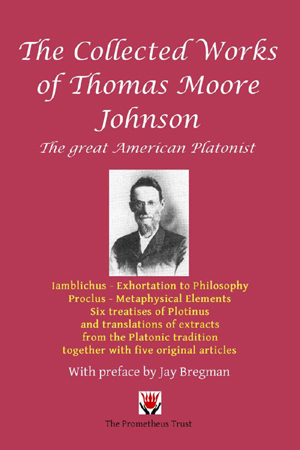
Collected Works of Thomas Moore Johnson

Wonderful news from the UK in the form of a publication of the works of TMJ by The Prometheus Trust with a scholarly introduction by Jay Bregman of the University of Maine.  This will be very helpful in editing the correspondence of Johnson with Alexander Wilder, as the discussions are largely about Platonism and related subjects.

The publisher’s website contains this summary of the book and table of contents.

The Collected Works of Thomas Moore Johnson

The Great American Platonist

With a Preface by Jay Bregman

Thomas Moore Johnson (1851-1919) can rightly be said to be a great American Platonist: he was one of a number of men and women of that period who sought to promulgate the philosophy of the Platonic tradition as a spiritual and intellectual discipline. Had not the tide of rationalist and sceptical thinking run so strongly in the last one hundred years, Johnson – along with his fellow philosophers such as Hiram K Jones, William Torrey Harris and Bronson Alcott – would today be recognised as a great contributor to the cause of true philosophy in the modern west.

Johnson edited two journals, The Platonist and Bibliotheca Platonica, between 1880 and 1890, as well as publishing three books in the following years. This book presents much of Johnson’s work during this time – translations of Iamblichus’ Exhortation to Philosophy, Proclus’ Elements of Metaphysics, many of his translations of the treatises of Plotinus (including three which had never before been translated into English), as well as several smaller translations of important Platonic fragments and many of his original writings.

Contents:

Iamblichus’ Exhortation to Philosophy (or Protrepticus), 9781898910824fc2
Proclus’ Elements of Theology (or Metaphysics)
Fragments from the Epistles of Iamblichus
Fragments of Ammonias Saccas
Proclus on the Chaldean Oracles
Two Hymns of Synesius
Six treatises from Plotinus’ Enneads:-
On the Nature of Living Itself & on the Nature of Man I, i
On the Essence of the Soul (1) IV, i
On the Essence of the Soul (2) IV, ii
On the Descent into Body  IV, viii
Intelligibles not external to Mind, and on the Good V, v
Diverse Cogitations  III, ix
Original Writings:-
Plato’s Basic Concepts
Plato and his Writings
The Platonic Theory of Education
Plato and his Philosophy
Three Fundamental Ideas of the Human Mind

432pp Hardback £18  ISBN: 978-1898910-824

Categories
Blog

Private Lessons and Teachings Archive expansion

The latest major expansion of the holdings of IAPSOP, the International Association for the Preservation of Spiritualist and Occult Periodicals, was announced by founder Marc Demarest this month.  He wrote:

Private lessons and teachings boomed after the mail order revolution of the 1880s and 1890s, but were related to far older practices like phrenological, astrological and psychometric readings-by-mail. Private lessons and teachings allowed a mage to develop an apparently more intimate relationship with his or her students, to reach sparse markets of students scattered, literally, all over the globe, and to monetize his or her teachings more effectively, by selling the same material, over and over again, in dozens, hundreds or thousands of transactions. Private lessons and teachings also had other beneficial effects, for the mage and the movement, promoting regular interchange between a student and the movement’s leader or headquarters, and reducing the cost of the production of materials (little more than paper, a typewriter and a method of duplication was required to produce lessons). Occult lessons-by-mail also opened up new suppression mechanisms for the State, making occult teachers subject to postal fraud regulations, and served as further evidence, in the hands of mail-order detractors, that the mail-order business model was a serious social ill that needed to be legislated out of existence.

This provides context for the authorial partnership that I was investigating when I learned of the Thomas Moore Johnson correspondence, the still-mysterious collaboration of Thomas H. Burgoyne and Sarah Stanley Grimke.  The Johnson letters reveal that within a few months of publishing her First Lessons in Reality and joining the Hermetic Brotherhood of Luxor in 1886, Grimke was being promoted by Burgoyne as required reading material for HBofL initiates.   Although details of their subsequent collaboration are unknown, it was plausibly reported by Elbert Benjamine that they were co-authors of The Light of Egypt, first published pseudonymously as the work of “Zanoni” in 1889.  Few of the 48 teachers included in the Private Lessons archive are remembered today, even to the small extent that Burgoyne and Grimke have been.  But the expanded holdings of IAPSOP may eventually change that, as increased accessibility of occult and Spiritiualist books and periodicals has already been useful to many scholars around the world.


Categories
Blog

Kenneth R.H. Mackenzie

In The British Birth of the Occult Revival, 1869-1875, an article which he has posted on academia.edu, Patrick D. Bowen analyzes the implications of an 1869 series of articles by Kenneth R.H. Mackenzie, one of the correspondents of Thomas M. Johnson appearing in the new collection Letters to the Sage.

As a participant in the Societas Rosicruciana in Anglia (SRIA) Mackenzie wrote  a series of “Papers on Masonry” for the newly-created Freemason magazine. About the series of articles, Bowen writes:

He explains, firstly, that myths and symbols are important, as they help convey deep truths that scientific language cannot. Next, he says that Masonry has worn out its usefulness in the world, and that the only way the Masonic ideals of world peace, justice, and equality (for all religions and races, by the way) can be achieved in the world is by introducing a new set of myths and symbols, one that embraces the teachings of both the East and West and scientific and ‘occult’ thought. Furthermore, he continues, a new prophet—a man who understands the truths of all the world’s sciences and knows how to communicate them via myths and symbols—must offer this new set of myths and symbols to the world. While he is explaining this, Mackenzie starts dropping clues that he is aware of a number of other Masonic-like orders in the world… ‘Papers’ is, basically, a rational justification for the invention of new occult doctrines. It seems that, after studying myths, religions, and cultures in the 1860s, Mackenzie had come to the conclusion that he might actually create the open and free world he had been envisioning since the 1850s by using Masonry as his organizational blueprint and Masons as the initial proselytes…

This is relevant to the origins of both the Theosophical Society and the Hermetic Brotherhood of Luxor, both of which used terminology from Mackenzie’s masterpiece:

At least partially driven by this view, between 1875 and 1877 Mackenzie published a multi-part work, the Royal Masonic Cyclopaedia, which presented as fact all the occult claims made by the SRIA members. This book quickly became seen by other influential Western occultists as an important sourcebook for modern occult ideas, thereby giving these individuals intellectual legitimization to start their own groups, some of which became extremely popular themselves.

Patrick’s blog includes this useful summary of highlights of Letters to the Sage:

Some highlights of the book’s contents:
  • Details about the organizational development of the TS and HB of L in the U.S.
  • The 1887 ‘ordinance’ Johnson sent out to establish the ‘Sufic Circle’ as a branch of the Hermetic Brotherhood.
  • Evidence for the earliest known organized practice of Yoga in the United States.
  • Information about previously unknown Rosicrucian groups and teachers in 19th c. America.
  • A full list of the HB of L’s teaching materials and details of the process of the distribution of the materials.
  • Letters from H.S. Olcott and Thomas Burgoyne.
  • 1880s discussions of the Tarot and Eliphas Levi.
  • Previously unknown HB of L practical occult teachings.
  • The names of dozens of HB of L members and their ‘pledge’ dates.
Categories
Blog

Letters to the Sage published this week

Although my copy has not arrived yet, the book is available now in paperback on Amazon and will be out on Kindle by the end of the month.  I created a Facebook page for the book which includes several pages of previews and ordering information and does not require a Facebook account to read.

Patrick Bowen has posted longer excerpts on academia.edu, which does require an account to access but which is free of charge.  Another article posted there by Patrick features one of Thomas M. Johnson’s British correspondents and sheds new light on the Masonic roots of the the Hermetic Brotherhood of Luxor, Theosophical Society, and related groups.  It will be the focus on next month’s blog post.

Meanwhile, for the astrologically inclined here is the natal chart for the book:

Categories
Blog

Letters to the Sage, a preview


As publication date approaches, I will share some general information about the forthcoming book from Typhon Press, the first of two volumes of the selected correspondence of Thomas Moore Johnson, the “Sage of the Osage.” The correspondence begins in the 1870s and continues into the twentieth century, but most of the letters were written during the short life of Johnson’s journal The Platonist in the 1880s. Over half the book consists of letters associated with the Hermetic Brotherhood of Luxor during Johnson’s brief period as its leader in the US. Three of the 48 authors shed more light on the HBofL than any of the rest: 1) Thomas H. Burgoyne, whose esoteric lessons are illuminated by his correspondence with Johnson, 2) Henry Wagner, who succeeded Johnson as leader and who became Burgoyne’s publisher, and 3) Silas H. Randall, a Cincinnati inventor who was Johnson’s chief assistant in management of HBofL affairs and wrote far more letters than any other correspondent. Randall is not only the most prolific of the letter writers, but in my judgment the most interesting and engaging. He was extremely well-read and an avid student of both philosophy and religion, sharing personal views and experiences with Johnson and commenting insightfully on the Brotherhood as well as the Theosophical Society.

The most prolific correspondent associated with the TS was Elliott B. Page of St. Louis, almost as closely involved with Johnson as Randall but writing largely about Theosophy rather than Hermeticism. More familiar names to Theosophists are those of Abner Doubleday, G.R.S. Mead, Henry S. Olcott, William Q. Judge, and Dr. J.D. Buck, each of whom wrote several detailed letters to Johnson. The world of Freemasonry is represented by letters from Kenneth Mackenzie and John Yarker, while Rosicrucianism was the preoccupation of Freeman B. Dowd and Richard Goodwin. Neo-Hermeticists unaffiliated with the HBofL are represented by letters from Anna Kingsford and Edward Maitland.

In conversations with Church of Light members, I have referred to the Nag Hammadi Library and Dead Sea Scrolls discoveries as akin to the finding of the Johnson letters by his descendants three years ago– completely unanticipated primary source material that drastically revises what we know of our origins. Working with these letters has pushed other projects into the background, and another volume of transcriptions and annotations lies ahead. Although I have two chapters in forthcoming multi-author collections, and two introductory essays for future reprints of 19th-century authors, the focus of this blog will be on the Johnson letters over the next two years. With 88 US members of the HBofL named in Johnson’s records, and 48 correspondents whose letters survive, there will be abundant opportunities to feature various of the little-known as well as the more famous of Johnson’s associates.

As a postscript to my series of posts about Chevalier Louis de B, I need to mention yet another candidate noticed by Marc Demarest who has written a blog post about the French Comte de Bullet. As for my promised comment on pseudonymity in the occult literature, suffice it to say that Britten is like a “stone rejected by the builders,” whose fictionalization of various acquaintances was an example followed by many after her, none of whom gave her any credit or respect as far as I can determine.

Categories
Blog

Burton the Adept

Part II of Ghost Land, provocatively titled “The Adept,” opens twenty years after the close of Part I with “autobiographical sketches of the Chevalier de B___ continued”:

To traverse many lands, sound the heart-throbs, listen to the inner revealings, and learn the life mysteries of many a strange people…I have something that has followed me, or rather infilled my soul, through every changing scene, in every wild mutation of fortune—on the battle-field, in the dungeon, in the cabinet of princes, in the hut of the charcoal-burner, in the deep crypts of Central India, and amidst the awful rites of Oriental mysticism, in the paradises of love, and the shipwreck of every hope—something which has never forsaken or left me alone; something which stands by me now, as I write in my sea-girst island dwelling, on the shores of the blue Mediterranean (pp.; 233-234)

This passage describes neither Emma Hardinge Britten, Prince Salm-Salm, the Baron de Palm, the Duc de Pomar, the Countess of Caithness, Ernest de Bunsen, nor Emil Wittgenstein. But it perfectly describes an early member of the Theosophical Society with apparent links to both Britten and Mme. Blavatsky.

Sir Richard Francis Burton (1821-1890) had been deeply involved in occult circles during his time at Oxford in the early 1840s– the same circles in which Emma Floyd was moving at the time, in which the central figure was Edward Bulwer-Lytton. By 1860 he had become the most celebrated British explorer of the mid-19th century. Burton first met Helena Blavatsky in Cairo in 1853 as he was preparing for his great trip to Mecca; this at least is the claim made by Albert Rawson in a colorful memoir written on the occasion of Burton’s death. In his youth, Burton was a soldier renowned for his mastery of languages, 29 according to one count. In the 1850s his expeditions to Mecca and the source of the Nile produced popular books about his adventures, and he continued to produce vivid travel narratives for the rest of his life, while a British diplomat serving in Asia, Africa, South America, and Europe. More relevantly to Chevalier Louis, Burton was a lifelong enthusiast of astrology and occult lore. Burton, like Emil Wittgenstein, was an honorary founding member of the British Spiritualist Association in 1873, and joined the Theosophical Society later in the decade. Both had provided testimony to the 1869 London Dialectical Society, which also recorded Lady Caithness and Bulwer-Lytton as witnesses. While there is no evidence of collaboration between Britten and Burton, Blavatsky’s connection with the explorer was documented by one of her closest associates. Albert Rawson, who introduced Burton to Blavatsky, claimed to have made four extensive journeys to the Middle East.

Ghost Land appears to consist of three authorial voices each with a different relationship to Emma Hardinge Britten. Louis in Part One is a continental male version of Emma and the narrative rests on her own extensive experience in the occult milieu. Here Britten loses control of her narrative by sometimes forgetting whether she is herself or Louis. Louis in Part Two has matured into a much more masculine character, whose adventures and traits reflect those of Richard Francis Burton. In this section, Emma reveals herself to have only secondhand and vague ideas about India, and writes with the same combination of enthusiasm and misinformation that characterizes Blavatsky on India before 1878. It is therefore unlikely that either was directly assisted by anyone as well-informed as Burton; yet they were both acquainted with him and no other mutual acquaintance emerges as an inspiration for the Indian Louis. Blavatsky, however, is clearly implicated in the character Madame Helene Laval, a dangerous sorceress who attempts to seduce Louis and later becomes involved with a new sect in India.

next month: thoughts on adepts and pseudonyms

Categories
Blog

Prince Emil Wittgenstein and Ghost Land

Among the settings of Ghost Land, India and Russia stand out as places of which Britten had no personal, and little general, knowledge. Mme. Blavatsky must figure among the influences on the depiction of both countries, since she was in very regular contact with Britten during the simultaneous writing of Ghost Land and her Isis Unveiled. Blavatsky appears in Part Two of Volume One of Ghost Land disguised however not as Louis but as Madame Helene Laval, an evil sorceress and seductress. A Russian subplot involving Professor von Marx and John Cavendish Dudley suggests another influence that led Britten to include this digression. While Blavatsky was the only Russian in personal contact with Britten during the writing of Ghost Land, an eminent German/Russian Spiritualist was in regular correspondence with both during this period. The jovial family man and ardent Spiritualist John Cavendish Dudley, who accounts for the Russian content of Ghost Land, might reflect Britten’s correspondence with Prince Emil Wittgenstein.

The prince is described by Britten as “Prince Emil Sayn Wittgenstein (late aide de camp, and trusted friend to the Emperor Alexander II)” who in “a private letter to Mrs. Hardinge Britten, dated 1876,” wrote: “The Emperor and most of his household…. are not only Spiritualists in belief, but they would be partisans of the faith, did circumstances permit…although Spiritualism is known and believed in, alike by peer and peasant, it must be believed in against authority, — and be assured, my friend, it has a warm place in the hearts of thousands who dare not openly avow their convictions.” She continues, “from similar friendly communications from Prince Emil Wittgenstein, the author learned that the late Emperor of Russia possessed the most complete library of Spiritual works that the literature of many nations could supply. This noble gentleman was one of the earliest subscribers to a work translated and edited by the author, entitled `Art Magic,’ and in an autograph letter addressed to the writer of that work, he declared, “that he esteemed it as his most sacred authority, and carried it everywhere with him.”

Born in Darmstadt, Wittenstein had served Prince Alexander of Hesse in the Caucasus from 1845 through 1847 and then fought in Denmark, but returned to the Caucasus in service to Russia as aide-de-camp to Prince Vorontzov, Viceroy. There he remained until 1862 when he became Attache to Grand Duke Konstantin in Warsaw. Wittgenstein was part of the Emperor’s suite during the 1877-78 war with Turkey. Another passage from Nineteenth Century Miracles gives a fuller account of her communications with Wittgenstein, and claims to have predicted his demise and that of the Emperor:

This noble gentleman not only held high rank in the Russian army and served as aide-de-camp to the Emperor during the unhappy war with Turkey, but few of those who approached His Imperial Majesty’s person, enjoyed the royal confidence in the same degree. In a correspondence maintained during some years with the author of this volume, Prince Emil asked for and obtained a number of volumes of the best American literature for the Emperor’s library. Previous to the fatal war with Turkey the Emperor and Prince Wittgenstein both received assurances through Mrs. Britten’s Mediumship that their lives would be spared during the conflict, but be sacrificed—the one to the insurrectionary spirit at home, the other to the feverish effects of the deadly campaign, into which he was about the plunge. Both these gentlemen placed implicit faith in these prophecies…

This direct testimony of personal involvement with a source exceeds Britten’s remarks about any other possible models for Louis or Dudley. A correspondence lasting several years with a Spiritualist member of the nobility could be as important an influence on the Russian content of Ghost Land as the author’s acquaintance with Blavatsky. Britten’s emphatic name dropping in Nineteenth Century Miracles continues with the last passage about the prince the most striking of all:“Prince Emil Wittgenstein, who was one of the Russian Emperor’s lieutenant generals in the late unhappy Turkish war, wrote to Mrs. Britten that he regarded that book [Art Magic– ed.] as his `bible,’ carried it with him wherever he went, and had “often derived consolation and harmony of spirit from its noble teachings in moments embittered by the fever of war, and the cares of State.”

Categories
Blog

The Baron de Palm, Ernest de Bunsen, the Duc de Pomar

The candidates for Louis suggested within Emma’s lifetime were augmented by only one addition in the twentieth century. In the 1970 edition of Modern American Spiritualism, editor E.J. Dingwall proposed the Baron de Palm as the prototype for Louis. Joseph Henry Louis de Palm (1809-1876) is mentioned in Nineteenth Century Miracles as a “distinguished supporter of the movement in Germany.” Chicago journalist Melville Stone included de Palm in his memoirs:

I made the acquaintance of a remarkable character, one Baron de Palm. At first sight one would recognize him as a decayed voluptuary,
of the sort that frequent the Continental watering places of Europe in the season. Habited faultlessly, with hair and beard carefully dressed, washed-out face and eyes, shaky on his legs…He was a Bavarian. He was Baron Johan Heinrich Ludwig de Palm; had descended from a line of German barons running back ten centuries. He was Grand Cross Commander of the Order of the Holy Sepulchre. His father was a prince of the Holy Roman Empire, and his mother a notable Countess of Thunefeldt. Born at Augsburg in 1809, he was educated for a diplomatic career, and served his king with distinction at almost every capital.


(See this earlier blog post for the story of his alleged involvement with Lola Montez.)
After recounting a 1861 human levitation in a Vienna church in Nineteenth Century Miracles, Britten adds “This remarkable occurrence was also testified of by the late Baron de Palm, who was present on the occasion, and himself related it to the author.”

Dingwall comments that some had suggested William Britten as the author of the works attributed to Louis, but concludes “that both Art Magic and Ghost Land may have been the work of Baron Joseph Henry Louis de Palm, a very odd character with pronounced Theosophical and occult interests, whose funeral Mrs. Britten attended in 1876, and over whose body she pronounced an oration calling him `friend and companion..’” Although “Colonel Olcott thought that Baron de Palm was not capable of writing anything serious, and he may well have been right,” Dingwall suggests that “the Baron concealed his gifts with a view of preventing others from knowing what he was compiling under Mrs. Britten’s editorship.”

No one is on record proposing William Britten as the author of Art Magic and Ghost Land, or the basis for Louis as written by Emma, but we note Dingwall’s mention of unnamed adherents of this theory. Unnoticed by Dingwall but important to consider is that Louis is one of the names de Palm used in America (changed from the original Ludwig), making him the only suggested prototype with whom the name can be linked.

In a 2001 monograph, Robert Matthiessen nominated the German-British philologist Ernest de Bunsen as a prototype, which was analyzed by Marc Demarest in his 2011 edition of Art Magic. At the 2011 biennial convention of the Church of Light, Marc gave a presentation about Britten which went into detail about his reasons for nominating the Duke of Pomar, son of the Countess of Caithness, as a more plausible Louis prototype than any of those heretofore suggested. His blog provides this summary of the evidence.

Without criticizing any of the identifications to date, in November and December I will point out two aspects of the plot of Ghost Land that indicate yet more Louis prototypes. Emma had never traveled to India or Russia, but extensive subplots deal with each of those countries. Her acquaintance with two early TS members who did have great familiarity with each of those countries will be the topic of the last two blog posts of 2015.

This month marks the fifth anniversary of the opening of this blog, and December will be my tenth anniversary as a Church of Light member. In light of current developments, History of the Adepts will take an entirely new focus beginning in January 2016. Publication of the first volume of Letters to the Sage: Thomas Moore Johnson Selected Correspondence will provide detailed membership information on the early Hermetic Brotherhood of Luxor in the U.S. Henceforth, for the foreseeable future, the 48 individuals who corresponded with Thomas M. Johnson, and several dozen additional HBofL members named in the correspondence, will provide abundant material for all further investigations and reports.

Immersed for more than two years in hundreds of pages of this 19th century correspondence, I have felt blessed to experience the world of the HBofL members in a much more direct way than through their few published writings or official documents. In my books on Theosophy, letters and documents were important, but subordinate to a primary reliance on publications as historical evidence. With Edgar Cayce and Pell Mellers, publications receded to a more subordinate status, with documents and correspondence assuming a larger role in historical interpretation. But now, with the correspondence of HBofL members, publications are literally mere footnotes to the more immediate and vital encounter with the past found in handwritten letters.

For an online course in historiography, Steven Stowe, Ph.D. writes:

Few historical texts seem as familiar – or as compelling to read – as personal letters and diaries. They are plain-spoken, lively, and full of details. Both letters and diaries seem to emerge directly from the writer, fresh and intimate, bringing us close to who that person was. Both satisfy us by showing how people in the past shared many of our hopes, worries, and common sense. At the same time, both fascinate us by revealing differences between times past and our own time. They make us curious to explore differences in language and expressive styles, in what people felt needed saying and what did not. These differences in turn point to historical changes and continuities in self, social relations, work, and values, which personal letters and diaries capture with special sharpness.

Categories
Blog

Chevalier Louis de B_: How Many Prototypes?

Ghost Land is foundational to the Theosophical literature, chronologically and thematically, introducing adept brotherhoods further elaborated in later writings. Presented as a translation by Emma Hardinge Britten of an original text by the pseudonymous Chevalier Louis de B_, the book has inspired multiple guesses about the Chevalier’s identity. A companion volume to Art Magic, Ghost Land was published the same year, 1876, in the form of a memoir. The book’s authorship spans the early period of the Theosophical Society, with its first sketches appearing in 1872 before Blavatsky’s arrival in New York and its final section published in 1892 after her death. Chevalier Louis has never inspired a personality cult, and no one has ever claimed to speak on behalf of his Berlin, Orphic, or Ellora brotherhoods. Nevertheless Ghost Land is clearly a historical prerequisite for the full blown Theosophical (and post-Theosophical) elaboration of the Masters. Despite the fact that Britten later was a critic and opponent of the TS, Art Magic and Ghost Land both relied upon a network of support that included many early Theosophists as well as Spiritualists. Several Theosophical Spiritualists in Europe contributed to the character of Chevalier Louis de B_, in my considered opinion.

Eight years after Ghost Land, in Nineteenth Century Miracles (1884) Britten expressed second thoughts about aristocratic Spiritualists asking her to write about them using pseudonyms.

Since then Spiritualism in Europe takes the deepest hold of those whose rank and station induces them to shrink from subjecting their personal experiences to public criticism, the author too frequently becomes the recipient of valuable testimony which cannot be made available, because the communicants insist on withholding their true names and addresses. “Miss E.” and “Mrs. D.;” “Captain A.” and “My Lord X.Y.Z.” are impersonals, whom no one places any confidence in. There is no satisfaction in offering such shadowy testimony to those who are asked to believe in occurrences of an unprecedented and often startling character. Resolving as we have done, not to demand credence for phenomenal incidents upon any testimony open to the charge of unreliability, we feel obliged to relegate an immense mass of interesting matter of this kind to the obscurity which unauthorized statements justly incur.

Her former enthusiasm for pseudonymous collaborators seems completely absent in this 1884 book, but in 1892 Britten is once again writing on behalf of Chevalier Louis in Book II of Ghost Land.

Shortly after Art Magic was published, Emma was accused of being its sole author. Incredulity at her descriptions of Louis was expressed publicly, although anonymously, by a fellow Founder of the Theosophical Society. Charles Sotheran, in a review for Woodhull and Claflin’s Weekly, [July 6, 1876] called it “simply a rehash of books readily available…wretched compilation which is full of bad grammar and worse assumptions.” The judgment by a personal acquaintance, published so soon after publication, condemned Louis as a fictional mouthpiece for Emma herself.

Emma as sole author of Ghost Land was also the conclusion reached by Arthur Edward Waite, who discussed Louis in his memoir Shadows of Life and Thought:

Mrs. Britten has told us, in her preface to Ghostland (1) that its autobiographical sketches were “written originally in German”, but as she did now know that language, the Chevalier put them for her benefit into “rough English”; and (2) that they were written, like Art Magic, partly in French, and partly in English, for the same reason. In the dilemma of this lapsus memoriae I am content to leave the question whether the Chevalier lived only in the second-rate and typically feminine imagination of Emma Harding because, in the universe of evidential things, there was no room for him anywhere else.

Despite all the subsequent proposals, the conclusion that Ghost Land was predominantly written by Emma herself is inescapable in light of bibliographic evidence, and her authorship of its companion volume Art Magic. (Marc Demarest’s 2011 edition of Art Magic presents detailed analysis of the text leading to this conclusion.) The conflicting personal details about Louis noted by Waite confound any attempt to identify him solely with any one prototype. Nevertheless, rather than concluding that there were no real prototypes for Louis, I conclude that there were several, which accounts for the conflicting information provided by Britten. She first alleges that the manuscript was in German, which she had translated by an Americanized German, and a few pages later writes that Ghost Land and Art Magic were both written in French and English. In the 1876 manuscript Louis is the son of a Hungarian nobleman and his Italian wife, but in the 1872 sketches his father is English and his mother Austrian. Such inconsistencies suggest that Louis is an invention of his alleged editor, but if Louis is primarily Emma Hardinge Britten, the sole author of Art Magic and Ghost Land, the question remains of Chevalier Louis as a character related to figures in her past and then-present social networks.

Other than Emma, only one person was publicly suggested during her lifetime. The first suggestion of a Louis other than Britten came in the December 7, 1876 Spiritual Scientist, in which editor Gerry Brown’s review of Ghost Land included opening remarks suggesting “It is a singular coincidence that the circumstances therein narrated should correspond so closely to the historical facts concerning the Prince Salm-Salm, a person who has visited this country, is well known in England, and a profound occultist. If he is numbered among Mrs. Britten’s friends we name him as the author of `Ghost Land’ and `Art Magic.’” The Springfield Republican for December 19, 1876 repeated the Salm-Salm identification of Louis: “We suppose the editor, Ms. Emma Hardinge Britten, would object to having the book classed among works of fiction, but it certainly will not be received as a record of fact by the reading world…. Mrs. Britten describes the autobiographer as now living, and her personal friend, yet we have seen the late Prince Salm-Salm named as the original; he was a noted occultist.”

Felix Constantin Alexander Nepomuk, Prince de Salm-Salm (1828-1870) was a Prussian military officer who studied at a military school in Berlin before serving successively in the Prussian, Austrian, and United States armies. While in the United States he married a Vermonter, Agnes Joy, who accompanied him on the Civil War battlefields. After the war they returned to his estate in Germany. He was killed in battle in 1870 during the Franco-Prussian war. Nepomuk’s career in the Prussian military and later association with Austria fits some elements of Louis’s persona, but there is no evidence that he was an occultist. He could not have collaborated in the writing of Ghost Land because he died in 1870. His American wife Agnes had a connection to Cuba, and a recorded interest in Spiritualism, both of which are relevant to Louis. Salm-Salm left us a book, My Diary in Mexico in1867, Including the Last Days of the Emperor Maximilian; with Leaves from the Diary of the Princess Salm-Salm, etc., Agnes also left a memoir of her own, Ten Years of My Life, in which she describes the couple’s dabbling in Spiritualism in 1863:

Though I, as I said before, resisted this epidemic on the ground of religion and common sense, I could not help becoming interested in this strange aberration, and feeling tempted to witness some manifestations of spiritualism. The Prince, however, tried to dissuade me from such an attempt, as he was afraid that the excitement would act too strongly on my imagination. I therefore abstained from visiting some of those public exhibitions of professional spiritualists, but did not resist the entreaties of Mrs. Speirs to have some spiritual entertainment at home, against which good Salm had no objection…

10/16/2015– adding this segment about Edward Bulwer-Lytton as it fits better chronologically here than with the next several prototypes:

The second suggested male prototype for Louis came from G.R.S. Mead, prominent Theosophist and secretary to Blavatsky in her London years, who was quoted by A.E. Waite that Louis was the “inner life” of Edward Bulwer Lytton (1803-1873). The prolific novelist had attained great success by the early 1830s, and his Godolphin (1833) was translated into Russian by Helena Pavlovna Hahn, mother of Madame Blavatsky. Lytton wrote poetry and plays as well as dozens of novels, and was prominent in political and diplomatic life, serving as Secretary for the Colonies in the late 1850s. His obsession with occultism and Rosicrucian lore is most apparent in Zanoni (1842) and A Strange Story (1870), and Britten named him first among the participants in what she called the Orphic Circle. His interest in practical occult experimentation was unrivaled in Victorian England, which lends credibility to Britten’s late-in-life revelation of his name.

Waite gives no citation, but had aligned himself with Sotheran’s position that Britten herself was Louis.  In Old Diary Leaves, begun in 1895 while Emma was still alive, Col. Olcott hinted at agreement with both the Britten and Bulwer-Lytton theories., writing that Sotheran in Woodhull and Claflin’s Weekly “Uses very severe language in regard to the reputed Author, whom he indentifies [sic], whether justly or unjustly, I cannot say, with Mrs. Britten…This is exaggerated censure, for the book does contain passages worthy of Bulwer-Lytton; in fact, one would say they were written by him”…[i Stylistically, Ghost Land echoes Bulwer-Lytton more than any other novelist. Bulwer-Lytton, among Emma’s claimed acquaintances, was well connected in continental occult milieu, and might have inspired her treatment of this aspect of her story. His influence on Blavatsky’s Isis Unveiled is relevant to Ghost Land.

In a 1957 study, Sten Liljegren analyzed the influence of Bulwer-Lytton’s novels on Isis Unveiled, and more broadly on Blavatsky’s development of Theosophy. Without mentioning Britten, he notes a characteristic of Zanoni that also is found in Ghost Land, which is that after publication, the author “kept up the fiction that he was not the author of Zanoni but only the editor of papers which were left to him by a Rosicrucian, which formed the novel in question.” Disclaiming authorship of parts of one’s body of work became a theme for both of Bulwer-Lytton’s Theosophical disciples. In the 1870s, Britten took the strategy to greater extremes than Blavatsky, since Isis is portrayed as the latter’s work regardless of tales of adept collaborators, while Art Magic and Ghost Land are attributed entirely to Louis. Ghost Land and Isis Unveiled are equally indebted to Bulwer-Lytton’s portrayals of adeptship and initiation. In an 1877 letter to Stainton Moses Blavatsky wrote of Bulwer-Lytton that “He was an adept and kept it secret – first for fear [of] ridicule—for it seems that [is] the most dreaded weapon in your 19th century—and then because his vows would not allow him to express himself plainer than he did…”

(the above is a modified excerpt from an essay for a future new edition of Ghost Land)

Categories
Blog

The First American Sufis

This week marks the publication of the first volume of Patrick D. Bowen’s three volume series A History of Conversion to Islam in the United States. The publisher’s website provides this description of the book’s contents:

A History of Conversion to Islam in the United States, Volume 1: White American Muslims before 1975 is the first in-depth study of the thousands of white Americans who embraced Islam between 1800 and 1975. Drawing from little-known archives, interviews, and rare books and periodicals, Patrick D. Bowen unravels the complex social and religious factors that led to the emergence of a wide variety of American Muslim and Sufi conversion movements.

While some of the more prominent Muslim and Sufi converts—including Alexander Webb, Maryam Jameelah, and Samuel Lewis—have received attention in previous studies, White American Muslims before 1975 is the first book to highlight previously unknown but important figures, including Thomas M. Johnson, Louis Glick, Nadirah Osman, and T.B. Irving.

The publication date is September 14, but Google Books has had excerpts available online for several weeks. Fortunately for readers of this blog, large portions of the chapters discussing Thomas M. Johnson are available in previews. Here is a link to Johnson as a search term in the text. The second and third chapters provide more new information about the Hermetic Brotherhood of Luxor and the early Theosophical Society in US history than has been published in two decades. There is such a wealth of information that the book provides fodder for many possible blog posts.  Here I will highlight only the discovery that was most unexpected and was made by Patrick after we had already completed a first draft of Letters to the Sage: Thomas M. Johnson Selected Correspondence, The Esotericists. Although almost all the letters come from the Johnson family archives in Osceola, Missouri, the ones revealing the existence of a secret Sufic Circle  were written to and by Jonathan S. McDonald of Lockport, Illinois and were located by Patrick in the collections of the Archives of American Art at the Smithsonian Institution. This group operated as a secret society within the secret society of the HBofL, and is the first known Sufi-identified group in the US.  As described in the book’s third chapter, on March 16, 1887:

Johnson, acting in his capacity as president of the H.B. of L.’s American Central Council, sent out an “ordinance” to six leading American members of the occult order, asking them to vote on the establishment of this organization…the objects of the circle were “the systematic study of Sufism, the practical application and realization of its teachings, and the dissemination of its precepts and doctrines.”

The group appears to have been short-lived and there is evidence that it immediately created dissension in the HBofL. But the timing of its creation is especially significant in relation to two other events that occurred in 1887. Thomas H. Burgoyne, Secretary of the HBofL, corresponded with Johnson about spiritual practices and initiatory rites of the Brotherhood, and mentioned that he had an inner-plane encounter with a man to whom he referred as “the Arabian,” suggesting that Johnson also might have such an experience during his initiation. 1887 was also the year that Max and Alma Theon moved from England to France and then to Algeria. Burgoyne refers to Theon and “the Arabian” as separate individuals and gives no details about the latter’s existence on the physical plane. But even though layers of mystery surround Burgoyne, the Theons, and Johnson, this new book sheds more light on the beginnings of the HBofL in America than has been available since the groundbreaking 1995 publication of many of its teachings as The Hermetic Brotherhood of Luxor: Initiatic and Historical Documents of an Order of Practical Occultism.

Categories
Blog Sarah Stanley Grimké

All Roads Lead to Concord

One strange synchronicity is enough to make me say “hmm, wow” to myself; another involving the same subject is enough to make me write about it. Although my past pattern has been to devote years of concentrated effort to a single subject, and move on to another only after publication, lately I’ve been juggling multiple projects involving three publishers as a chapter author or co-editor rather than as sole author. The advantage of this situation is that I never get bored; the disadvantage is that I stay perpetually disoriented and confused. But sometimes a connection among multiple projects appears which tends to reduce the confusion and help me see them all as part of a larger whole.

Two weeks ago I finished revision of a chapter on the Bengal Renaissance for a forthcoming collection. At nine in the morning I thought to myself, “At last I have the free time to read something for pleasure; surely there must be a new biography of some Transcendentalist to enjoy.” So I went to Amazon and looked around a bit, but didn’t see anything that jumped out at me. At eleven, I heard a thunk and went to the front door where I found a box from a Church of Light friend in California with a letter enclosed along with several books she “thought I might enjoy.” Including, to my pleased consternation, The Lives of Margaret Fuller by John Matteson, whose previous joint biography of Bronson and Louisa May Alcott had given me great pleasure a few years ago. (No more or less than Eve LaPlante’s subsequent joint bio of Louisa and her mother Abigail May Alcott, which was also subject of a previous blog post.) Like many readers and as noted in Matteson’s introduction, most of what I knew about Fuller involved her tragic death. Now halfway through the biography, I find it as absorbing as his previous book, and even more enlightening about possible role models for Sarah Stanley Grimke who was born the year that Fuller died, 1850.

Synchronicity number two occurred this morning as I got in my car after hiking at the lovely Lauren Mountain Preserve in Bassett, Virginia. Just as I was leaving, on the radio Scott Simon of Weekend Edition welcomed author A.J. Jacobs, who electrified me with the opening line “My favorite teacher is Bronson Alcott.” Jacobs went on to joke that Alcott was really his children’s favorite teacher, and then discussed other pedagogical subjects. One reason I was intrigued by this line was that Fuller’s first real job was as a teacher in Alcott’s short-lived, ill-fated, but fascinating Temple School in Boston. But in addition to tying into my current reading, Alcott also figures in three different writing projects in which I’m involved. He was an acquaintance of both Sarah Stanley Grimke and Mary Baker Eddy, and hence figured in my research last year in Boston for a future reprint of Grimke’s Esoteric Lessons. But more immediately, he was a major influence on both Thomas Moore Johnson and Alexander Wilder. The first volume of Johnson’s incoming correspondence is now in the hands of the publisher and represents 48 authors who wrote to Johnson in the 1880s; the second volume is almost entirely letters to Johnson from Wilder and the editorial team has at least a year ahead of us working on annotations, introductions, appendices, etc. But we just finished the first arduous round of transcriptions, a relief because Wilder’s handwriting was more inscrutable than any of the 48 correspondents of volume I.

Johnson was inspired to create his journal The Platonist by acquaintance with Alcott during one of his “Western tours” and traveled to Concord to pursue the relationship and meet other Transcendentalists like Ralph Waldo Emerson. Wilder was one of the lecturers at Alcott’s Concord School of Philosophy, to which he regularly refers in his letters. The Bengal Renaissance chapter I just finished also ended up with a focus on Boston during the twilight of Transcendentalism, due to the connection between the Brahmo Samaj and Unitarians.

When I read about  Spiritualism, Theosophy, Christian Science, or New Thought my enthusiasm is purely that of a historical researcher. Duty rather than pleasure calls me to pursue those branches of literature. But the Transcendentalists, to my reading tastes, transcend the bounds of time and space and speak with voices as fresh today as in the mid-19th century. Not just their words, but biographies about them, inspire me with a sentiment akin to what Alfred North Whitehead said about Plato. If the history of Western philosophy is a “succession of footnotes to Plato”—which Wilder and Johnson would surely applaud—then the history of late-19th century American spiritual movements is a succession of footnotes to Transcendentalism.

The legacy of the Transcendentalists is apparent in New Thought, Theosophy, Christian Science, and of course Unitarian Universalism. But the Hermetic Brotherhood of Luxor and its modern heir The Church of Light are arguably even more profoundly indebted to this movement—which I hope to explain further in future blog posts. (post edited, 9/11/15.)

Photo of Hillside Chapel, Concord, Massachusetts, from Wikipedia

Categories
Blog Genevieve Stebbins

Genevieve Stebbins in Poetics of Dance by Gabriele Brandstetter

For each of the past few years there has been a scholarly book or two discussing the unique role of Genevieve Stebbins promoting fresh ideas about the meaning of dance and exercise in the late 19th and early 20th centuries.Newly available in English from Oxford University Press is Poetics of Dance by Gabriele Brandstetter. First published in German in 1995, the book is described on the publisher’s website as a “classic text in dance studies” which had been a “path-breaking publication, the first to explore the relationships between the birth of modern dance, new developments in the visual arts, and the renewal of literature and drama in the form of avant-garde theatrical and movement productions of the early twentieth-century.”

The section on Stebbins begins on page 46 and runs through page 52, and is viewable through Google Books.

Brandstetter writes that “Stebbins’s main contribution to modern dance– her emphasis on the dynamics of dance movement– is still underestimated even today. She was the first to no longer regard dance from the perspective of dance technique, muscular training, or the systematic development of articulation, emphasizing instead its energetic principles. Stebbins’s elaboration of the Delsarte system heralded a paradigm shift in modern dance in an attempt to redefine dance movement on the basis of a vitalist understanding of dynamics.” (p. 46)

While the impact of Stebbins’s life and work is increasingly recognized, the roots of her ideas in her early experiences with the Hermetic Brotherhood of Luxor are yet to be explored in depth.  We can hope that she will eventually be the subject of a full biography in which this influence will be discussed at length.

Categories
Blog

Upstate Cauldron by Joscelyn Godwin

Joscelyn Godwin’s new book is so entertaining and informative that I didn’t want to put it down and didn’t want it to end. With those conflicting desires, I read it slowly to savor all the wonderful eccentric characters and groups he describes in Upstate Cauldron. There are more than 40 according to the back cover, which includes a quotable endorsement from Mitch Horowitz who calls Godwin the “dean of alternative spiritual history” and concludes “This is both splendid history and a book of wonders in uncovering lost fragments of our world. Throw away your highlighter—because you won’t know where to stop.” The book succeeds equally as testimony to Godwin’s mastery of “alternative spirituality” chronicles and as a work of state and regional history. With abundant maps and photographs, and a gazetteer of sites of interest, it deserves a place on the bookshelves of history enthusiasts throughout the upstate region.

Two chapters are of particular interest to the Hermetic Brotherhood of Luxor. In chapter 14 Godwin gives an engaging summary of the life and works of Paschal Beverly Randolph, who influenced the HBofL teachings posthumously. Chapter 18 describes Josephine Cables Aldrich’s role in Rochester formation of both the first Theosophical Society branch in America and the first HBofL group.

At the end of the book I was left wishing for 49 more like it, one on each remaining state. But there is no other state like New York in terms of eccentric 19th century spiritual movements. In his thoughtful concluding chapter, Godwin calls on Charles Fort’s observation that “anomalous phenomena tend to cluster in time and place.” As one eerie example of this, he explains the geographical clustering of the origins of Mormonism, Spiritualism, and Adventism within a few square miles of Upstate New York:

Hiram Edson’s vision of Christ in the cornfield in 1844 (see chapter 8), which became the theological foundation of Adventism, happened between Clifton Springs and Port Gibson. That is about five miles from the Sacred Grove outside Palmyra, where in 1820 Joseph Smith met God the Father and Jesus Christ, and about four miles from Hydesville, where in 1848 the Fox sisters started talking to the dead. So three lasting religious movements—Adventism, Mormonism, and spiritualism, were all sparked off in that little triangle.

Categories
Blog

Major Expansion of IAPSOP Holdings

The International Association for the Preservation of Spiritualist and Occult Periodicals has just announced the addition of many new periodical titles, and additional volumes of its previous holdings, amounting to 330 new items in all.  Marc Demarest’s blog post describes the great collaborative effort involved with many colleagues for several months.

Among the very rare titles newly added in IAPSOP is The Occult Word, edited by Josephine Cables, one the founding figures of the Hermetic Brotherhood of Luxor in America.  Another title of special interest in the history of the HBofL/CofL is Thomas M. Johnson’s The Platonist, of which IAPSOP holdings are expanded with additional volumes.  Cables, who was also a founding member of the Rochester, NY lodge of the Theosophical Society, is featured in one chapter of Joscelyn Godwin’s new book Upstate Cauldron, which I am now reading and which will be reviewed in my June blog post.

Categories
Blog

Heirs to Forgotten Kingdoms

The quest which led to this book developed over more than a decade during which Gerard Russell worked as a British and UN diplomat in some of the most difficult postings imaginable, including Baghdad, Cairo, Cabul, and Jerusalem. His intellectual adventure, exploring the surviving remnants of religious groups that are secretive and little-known, engages the reader with a sense of constant discovery. The physical courage involved in some of his travels is inspiring and reminiscent of a 19th century British diplomat, Richard Francis Burton, who combined travel adventure and spiritual exploration in his writings. Each of Russell’s chapters is devoted to a different group: Mandaeans, Yezidi, Zoroastrians, Druze, Copts, Samaritans, and Kalasha. The largest of these groups, the Copts, number several million, while the smallest, the Samaritans, are estimated to number 750. Every chapter is intriguing but I will limit my comments to the two which are of special relevance to the idea of the “Religion of the Stars.” We tend to think of this in terms of Hermeticism and modern astrology, but Russell’s investigations include groups of ancient origin but still surviving, almost unknown in the Western world and little understood in their homelands, that offer another angle on the subject..

The first chapter describes the Mandaeans who “believe in a heaven, but it is called the Light-World” and think their secret wisdom originated with Adam. Their earliest texts have been dated to 300-500 AD, and show some influence by Judaism. They honor John the Baptist but not Jesus, and practice baptism. Russell writes: “Mandaeans believe themselves to be sparks of the cosmic light that have detached themselves from it and become trapped in a material home. When liberated by death from their bodily prisons, these sparks of light can ascend back to the great light from which they came.” The Mandaeans, historically rooted in southern Iraq, now number fewer than 100,000 in total membership. Heirs of Babylonian astrology, Mandaeans use the terms “the Seven” and “the Twelve” to refer “to the stars and planets as supernatural, quasi-divine beings.” Sadly, in the wake of the 2003 invasion and subsequent civil war, “More than 90% of the Mandaean population of Iraq has emigrated or been killed. It is only in southern Iran that one can find their communities intact.”

My greatest interest was in the chapter on the Druze which emphasizes their Pythagorean roots. Russell quotes Najla-Abu Izzeddin describing their beliefs: “The Druze Faith reaches beyond the traditionally recognized monotheisms to earlier expressions of man’s search for communion with the One. Hence its reverence for Hermes, the bearer of a divine message, for Pythagoras…for the divine Plato and for Plotinus.” Half of the world’s one million Druze live in Syria,with most of the rest in Lebanon and Israel. After noting that Blavatsky associated the Druze with Tibetan Buddhism, the author emphasizes a more familiar perception of nineteenth century Europeans, which is that the Druze beliefs were similar to Freemasonry. In the 1890s the Rev. Haskett Smith argued that they “retain many evident tokens of their close and intimate connection with the Ancient Craft of Freemasonry.” In this he echoed the preoccupation of Masonic historian and Blavatsky associate Albert L. Rawson. In 1922 this alleged connection was the theme of a book by Bernard Springett, Secret Sects of Syria and Lebanon.

Russell reports, but does not endorse, such theories.  His book combines reliable history, clear explanation of doctrines, and engaging travelogue.  His travels in search of forgotten kingdoms occurred just as their heirs were facing persecution and extinction, which makes the book timely in the present, and of lasting value to the future.

Categories
Blog

The World's Worst Woman

This is an overdue appreciation of an exemplary book by John B. Buescher, whose previous investigations of Spiritualist history have broken new scholarly ground. As the second work to appear from The Typhon Press, and the first original study (following the scholarly edition of Art Magic edited by Marc Demarest) Empress of Swindle sets a high standard of thorough research on its idiosyncratic, fascinating subject. To introduce her, here is the back cover copy:

Ann Odelia Diss Debar was an adventuress who operated under many aliases during America’s Gilded Age. At one time or another, she was pursued by police on at least three continents. Often incarcerated, but never reformed, she made her name as a newspaper synonym for fraud carried out under the pretense of Spiritualist and occult powers. Her scandalous and bizarre career of con artistry intersected with those of Victoria Woodhull, the Vanderbilt family, Leland Stanford, Helena Blavatsky, and a host of other rich and powerful people. Her brazen exploits provided newspapers around the world with sensational copy for almost four decades, from 1870 to 1910, and earned for her the title of “the world’s worst woman.”

This is the first-ever biography of Ann Odelia Salomon, alias Princess Editha Lolita, alias Madame Diss Debar, alias Swami Laura Horos, ad nauseum. (Henceforth to be referred to as Diss Debar.) In light of the voluminous press coverage she received during her lifetime, it is surprising that no previous biographer has been drawn to her bizarre career. In a bibliography of 58 densely-packed pages, 90% of the citations are to contemporary press accounts from cities all over the US as well as in England and South Africa. Buescher meticulously follows her wandering path through hundreds of sources, but ends in a mystery, as no record of her death, or her life after 1910, was turned up in his exhaustive research. Empress of Swindle is thought-provoking in a way that seems to demand a re-reading to fully absorb the book’s import. It also provokes associated feelings, not just about Diss Debar but a host of other figures who were her contemporaries in Spiritualism and Theosophy. I have been described both as a hardheaded debunker and a softhearted apologist, with equal justification. But it is impossible to find a soft spot in one’s heart for an arch criminal like Diss Debar.

The use and abuse of pseudonyms in these movements is a longstanding interest of mine, and Diss Debar’s status as the “world’s worst woman” relies entirely on crimes she committed under false names. Some 19th century contemporaries may have adopted pseudonyms with harmless or benevolent intent, out of modesty or the desire to shield family members from controversy. Others combined selfish and altruistic motives, promoting themselves through concocted alter egos, yet imagining that they were serving a greater good. But everything done pseudonymously by Ann Odelia was harmful to others and to herself. From minor frauds as Princess Editha Lolita, to major theft as Diss Debar, to rape as Swami Laura, with a few likely murders along the way, her life path was one of endless destruction. And yet in a perverse way she was endlessly creative. In his concluding remarks Buescher contemplates her psychologically but leaves the reader pondering as to what drove her life of crime: “Where was she among all these aliases, false faces, invented and twisted lies?”

Categories
Blog

A Lost History of the Baha'i Faith

Books that simultaneously address family history and religious studies appeal to both of my literary obsessions, and hence tend to be among my favorite reading material. Several years ago Prophet’s Daughter by Erin Prophet told the story of the rise and fall of the Church Universal and Triumphant in a way no one else ever could; the author being the ultimate insider yet also a complete outsider. An insider in that she was a participant in all the events she describes, but an outsider in that she entirely rejects the belief system constructed by her parents. The finest book in the literature about Edgar Cayce, in my opinion, is Sidney Kirkpatrick’s biography Edgar Cayce: An American Prophet, because it goes into greater depth about the extended family of Edgar and Gertrude, their parents, siblings, children,and cousins, than any before or since.

It is not unusual for the descendants of a movement founder to find themselves at odds with the authorities who gain control of a religion’s governance. The entire family of Elizabeth Clare Prophet is now in such a position, but far more extensive are the descendants of Joseph Smith, Jr. Although the Utah Mormon church accounts for about 98% of LDS membership worldwide, most of the prophet’s descendants ended up in the Reorganized LDS church, which in 2001 became the Community of Christ. It is far more theologically liberal than the Utah church, for example having ordained women since the 1980s. According to certain traditions, the family of Jesus found themselves alienated from the authorities of the early Christian church. Although the Gospels name four brothers of Jesus and mention unnamed sisters, by the fourth century church authorities decided that he could not possibly have any siblings because Mary was a perpetual virgin, and this remains official church doctrine among Roman Catholics, Eastern Orthodox, and some Protestant groups. Although earlier historical records indicate that people had been recognized as blood relatives of Jesus in the first century, they were ultimately defined out of existence because they conflicted with a dogma based on metaphysics rather than history. But no case of a split between a prophet’s family and the religious authority structure of a faith community is as extreme and antagonistic as the example of the Baha’is. Eric Stetson has brought to light what he aptly entitles A Lost History of the Baha’i Faith, predominantly the unpublished writings of Shua Ullah Behai, grandson of the Baha’I founder Baha’u’llah. The collection includes the works of a dozen other individuals, almost all descendants of Baha’u’llah who have been not just alienated from, but demonized by the religious authorities who govern the contemporary Baha’i community.

The highest current authority is the Universal House of Justice, an all-male governing body that was first elected in 1963, six years after the death of the only Guardian of the Faith, Shoghi Effendi. The office of Guardian was ordained by the Will and Testament of Abdu’l Baha, oldest son of Baha’u’llah and grandfather of Shoghi Effendi, to last in perpetuity. But the Guardian was supposed to be a lineal descendant of Baha’u’llah, appointed by his predecessor; and Shoghi Effendi died without leaving a will and after excommunicating all his relatives, including his parents and siblings. Hence the Guardianship was declared abrogated. In this context as with the previous generation of leadership, excommunication is combined with shunning, and those shunned are called “covenant-breakers” and described as having a contagious spiritual disease. There are now several competing sects based on various claims by non-descendants to inherit the mantle of the Guardianship, but none of these have been supported by any of the Baha’I descendants. The new book now available is the work of an earlier category of “covenant-breakers,” those excommunicated by Abdu’l Baha, including two of his brothers and all their families—one of whom, a nephew, is the primary author of the book.

Stetson’s excellent introduction and conclusion are scholarly rather than polemical in tone, but the notes and comments in the body of the book show his admiration and sympathy for these excommunicated relatives. The surviving descendants who cooperated with Stetson and encouraged publication of the book have a positive message of inclusion and reconciliation. But like the great-great-great-nephews and nieces of Jesus, their very existence is an “inconvenient truth” to the belief system as it evolved under ecclesiastical authority over time.

The forthcoming volume of correspondence of Thomas Moore Johnson reveals a hitherto unsuspected connection between early American Baha’is and the HBofL. The phrase “Religion of the Stars” appeared as a catch-phrase of the astro-Masonic late 19th century group the Oriental Order othe Magi. The OOM, as it turns out, involved both Ibrahim Kheiralla, the first Baha’I missionary in the US, and some correspondents of Mr. Johnson. Mr. Kheiralla, who died in 1929, is one of the many “covenant-breaker” dissidents whose writings are included in A Lost History of the Baha’i Faith.

Categories
Blog

The Lost History of the Hermetic Brotherhood of Luxor

For the last eighteen months I have been working as co-editor for a book project that resulted from an astonishing treasure trove of letters, almost all from the 1880s, rediscovered in 2013 and soon to be published. Patrick D. Bowen, Ph.D., the lead editor, tells the story of the Thomas Moore Johnson correspondence in a new blog post. He had become interested in the Johnson Library and Museum in Osceola, MO in hopes that its collections might shed light on his research on the early history of conversion to Islam in America. At the same time I had become aware of the library/museum, and was planning to visit in search of evidence about the relationship of Sarah Stanley Grimke to the Hermetic Brotherhood of Luxor. Neither of us found much of what we had originally sought, and I was unable to make the trip to Missouri at all, but a serendipitous development led to an unforeseen collaboration. The Johnson family unearthed several hundred letters written to their distinguished ancestor by a diverse array of individuals, many of them literati, and placed them in the temporary custody of Missouri State University for preservation. Patrick traveled to Springfield to examine the letters, and was so struck by their value that he requested and obtained permission to edit them for publication. When Marc Demarest of the Typhon Press agreed to publish the letters, I volunteered to assist Patrick with transcribing and annotating them, as well as with mini-biographies of the correspondents. The subsequent collaboration has been richly educational and I feel honored to have participated in the project. Patrick’s 78 page introduction to the first volume is entirely his own work and an impressive feat of scholarship.

During the period of this correspondence, Johnson was a leading figure in the Theosophical Society and then in the H.B. of L., and the letters he received from the members of these two groups are a uniquely revealing time capsule. The import of this correspondence for Theosophical history is evident in many prominent T.S. names among the 48 letter writers, for example Olcott, Judge, and Mead. However, Johnson’s most informative and extensive lettters from a Theosophist were from Elliott B. Page, a heretofore little-known leader of the St. Louis Lodge. More than half of Johnson’s correspondents were associated with the H.B. of L., the best known among these being T.H. Burgoyne and Henry Wagner. But the most informative correspondent of all was the heretofore unknown Silas H. Randall, a Cincinnati inventor whose reading interests were as diverse and sophisticated as those of Johnson himself. The 48 authors of Letters to the Sage: Thomas Moore Johnson Selected Correspondence, Volume I: The Esotericists are a diverse cross-section of 19th century esotericism– Rosicrucians, Spiritualists, Platonists, and enthusiasts of  Tarot and Mind Cure along with Hermeticists and Theosophists, and even a Hindu yogi and a Muslim novelist from India.

Editing a reprint of Grimke’s Esoteric Lessons has proceeded simultaneously with working on the Johnson correspondence, and the research has been greatly enhanced by all the new information on the American members of the Brotherhood. The second volume of Johnson correspondence, to appear in 2017, will consist almost entirely of letters from Alexander Wilder. Here the subject matter has less to do with organizational than literary shared interests, as Wilder was among Johnson’s closest allies in the world of American Platonism. Wilder, Johnson, and Grimke were all acquaintances and admirers of Bronson Alcott, so my recent Mary Baker Eddy Library research on Transcendentalism was relevant to all three forthcoming books. More will be reported on the first volume of Johnson letters when the book is available this spring.

Categories
Blog Genevieve Stebbins Norman Astley

The Astleys Move to England, 1907

There is momentous news to report soon, but in the meantime I will share a small bit of information that has become available on the Web.  It is known that Genevieve Stebbins retired in 1907 from the New York School of Expression. She and her husband Norman Astley had previously owned property in the North Carolina mountains, but by 1913 were living in a small English town, Slindon in West Sussex.  Their return to the US was recorded in 1917 when they moved to California.

A brief notice was posted by Astley in 1903 in volume 18 of Recreation, indicating his interests as a naturalist, which were later shared by Elbert Benjamine:

In December 1907, Astley wrote a letter to The Country-Side, the monthly journal of the B.E.N.A., the British Empire Naturalist Association, indicating that he had been residing in Devon since at least April of that year.  The letter was published in 1908:

This is the first new information about the Astleys’ move to England that has emerged in several years.  It turns out that between their arrival in Devon and their move to Slindon they were recorded as boarders in the 1911 Channel Islands Survey, living in St. Peter’s Port, Guernsey.

Several new books have taken notice of Genevieve Stebbins in the past three years, which I will report in coming months.  Although nothing new has come to light about Thomas H. Burgoyne’s reputed demise in 1894, a wealth of new information will soon be published about Burgoyne’s first few years in America.  My next blog entry will share the story of an unexpected documentary find and the book that resulted.  One brand new find is a record of Burgoyne’s 1887 naturalization– either declaration of intent or actual application for citizenship– in Shawnee County, Kansas.  The circumstances of this event are explained in said forthcoming book.

ps– another piece of evidence turned up recently about the Astleys in England.  In 1914 they had acquired a lifelong lease in their rented home in Slindon, yet only three years later and before the end of the war the returned to the US.

Categories
Blog

A Search for Meaning in Victorian Religion (new biography)

For a chapter about Henry Steel Olcott in a forthcoming collection, I examined his friendship with Charles Carleton Massey, and became impressed by the generally admiring remarks from many sources about Massey’s honesty. Following his earlier book on the relationship between Spiritualism and Theosophy, Jeffrey Lavoie pursues that link further through a biography of one man who served as a “connecting rod” between the two movements.  Below is a review of the biography I posted on Amazon:

Until this book, Charles Carleton Massey has been a footnote in the lives of other more celebrated figures in the Victorian worlds of Spiritualism, the occult revival, and psychical research. Jeffrey Lavoie has honored him with a thoroughly researched and documented study that places Massey in a pivotal position as a “connecting rod” linking many better known contemporaries.

Each chapter of A Search for Meaning in Victorian Religion examines a different facet of Massey’s many related interests. Lavoie delves into Spiritualism and psychical research, explores the rise of esotericism in the late 19th century, relates Massey’s significance as a student and translator of German mystical and esoteric literature, and gives an intriguing account of his acceptance of anti-Masonic conspiracy theories and fantasies about Satanism. His final chapter provides well chosen excerpts from Massey’s writings that reveal him as increasingly focused on an esoteric interpretation of Christianity in his later years.

Of special interest to Theosophical history is Lavoie’s treatment of Massey’s progressive alienation from Madame Blavatsky, juxtaposed with his lifelong friendship with Colonel Olcott. No previous author in the field has appreciated all the cross-currents swirling around Massey as one of the original founders of the Theosophical Society who later had a similar role in the beginnings of the Society for Psychical Research.

There is less information available about Massey’s personal life than his intellectual life, but Lavoie provides as full a portrait of the private man as possible. The greatest strengths of the book are its excellent introduction and conclusion, which places Massey the public figure in context of intellectual history. Here Lavoie’s expertise as a religious historian and his deep personal sympathy for Massey combine to give an interpretative framework for the chapters about various phases of his subject’s life.

Recommended especially for scholars interested in Religious Studies and Victorian England, but accessible and interesting for general readers interested in Spiritualism, parapsychology, and esotericism.

Categories
Blog

Harmony and Divine Science

Malinda Cramer

Last weekend I made my first visit to a Divine Science church, something I’ve intended ever since beginning to work on the New Thought movement as context for the writings of Sarah Stanley Grimke. As with the recent connection to local Unitarians for the same reason, it was a very pleasant and encouraging experience that I intend to repeat. Among the many rare treasures now available on IAPSOP is a near-complete run of the journal Harmony, published in San Francisco from 1888 through 1906 under the editorship of Malinda Cramer, who more than anyone else is considered the founder of Divine Science. Several pieces of circumstantial evidence had suggested a connection between Sarah Stanley Grimke and Divine Science. Her friendship with Miranda Rice had begun in Massachusetts when both were students of Christian Science, and the year Rice moved to California, 1885, was the first year that Sarah visited there. Two years later, Sarah wrote to her daughter about Rice returning to Massachusetts and still being in touch by correspondence. According to The Encyclopedia of Cults, Sects, and New Religions, Malinda Cramer had sought a cure for her illnesses for several years but “In 1885, Cramer finally found her cure under the ministration of Miranda Rice, an early student of Mary Baker Eddy who had left the Church of Christ, Scientist, to open the first Christian Science Practitioner’s office on the West Coast.”(p. 283) Although Divine Science was founded in the San Francisco Bay Area, it found many disciples in Denver and after the great earthquake and fire of 1906, Denver became the movement’s headquarters. Since Sarah belonged to the Hermetic Brotherhood of Luxor which was headquartered in Denver when The Light of Egypt was published, it seemed likely that she was acquainted with Divine Science leaders in both California and Colorado. Generally the New Thought aspects of the Church of Light heritage seem more related to Divine Science than to Unity, Christian Science, or Religious Science.

The availability of Harmony online provides the first evidence of any friendly notice of Grimke’s writings during her lifetime. Heretofore I had found dismissive references to her in the Christian Science Journal in 1885 and 1886, but no friendly references in any periodical. In April 1893, the conclusion of a multi-part article by A.P. Barton of Kansas City, entitled “Why Are We Here?” quoted Sarah briefly. Because Sarah left the US in 1888 according to correspondence in the Grimke files at Howard University, we can find no record of her presence in either California or Colorado in the pages of Harmony. But we can find, here and nowhere else as yet, evidence that she was being read in New Thought circles during her lifetime.

Here is a timeline of Sarah’s life as far as I’ve reconstructed it thus far:

Sarah Stanley Grimké Timeline

1850 born in Scriba, NY where her father Moses Stanley is a Free Baptist minister

1851 moves to Fond du Lac, WI and another Free Baptist pastorate

1855 moves to Farmington, ME, another Free Baptist church, near her mother’s birthplace Wilton

1859 moves to Two Rivers, WI, as Moses becomes a Congregational minister

1860 moves to Hartland, MI where Moses becomes an Episcopal minister, which he remains through several more assignments in Indiana and Michigan

1873 attends the University of Michigan for one year

1878 graduates from Boston University with a Ph.B., having become a Unitarian

1879 marries Archibald Henry Grimke

1880 daughter Angelina Weld Grimke is born

1883 leaves Archibald and takes Angelina to live with the Stanleys in Michigan

1884 publishes Personified Unthinkables in Detroit

1885 travels cross country in New Thought circles, including Ohio, Missouri, and California

1886 publishes First Lessons in Reality, joins the Hermetic Brotherhood of Luxor in Los Angeles, CA

1887 returns Angelina to Archibald, never sees either of them again, begins collaboration in Monterey, CA with T.H. Burgoyne on The Light of Egypt

1888 writes to Archibald that she has been offered work abroad and intends to leave the country, asking for a divorce, which never occurs

1889 The Light of Egypt published under the pseudonym Zanoni

1898 dies in San Diego, CA; Moses Stanley reveals to Archibald and Angelina that Sarah had spent much of the intervening decade in Auckland, New Zealand before returning to the US around 1896

1900 Esoteric Lessons published posthumously in Denver

Categories
Blog

The Indo-Western Mind and the Hermetic Brotherhood of Luxor

Yesterday I heard a fascinating interview with a Unitarian minister from Maryland who is also a practicing Hindu. His family background in the Brahmo Samaj is mentioned only briefly, but relates to my current research about 19th century Indian interest in Western spirituality.

When I joined the Church of Light nine years ago, it was with a sense that it provided an opportunity to embrace what I had found to be constructive and valuable in esoteric traditions without having to engage with more destructive or distracting elements. And such has indeed been the case. But I also believed that my investigations into 19th century Indian history, which had brought so much encouragement from the scholarly world and so much discouragement from a few Theosophists, were all in the past and that the CofL’s roots were purely in the “Western Esoteric Traditions.” The latter expectation has been confounded many times over.

Elbert Benjamine names only four individuals as authors who are his precursors in giving “Brotherhood of Light” teachings; two English and two American. And nine years of historical investigations confirm that these four indeed represent the major writers whose teachings he incorporated into his systematic exposition of esotericism: Thomas H. Burgoyne, Emma Hardinge Britten, Genevieve Stebbins, and Sarah Stanley Grimke. Burgoyne, an Englishman, wrote mainly about astrology and also about Tarot. Britten was a Spiritualist historian with a background in earlier European occultism. Stebbins, a native Californian, was one of the first Americans to seek instruction in Yoga from qualified experts in the 19th century, and also wrote about physical culture and Tarot. Grimke, rooted in the Transcendentalist Unitarianism she embraced in her student years, became a Mind Cure author and then delved into astrology. These four Western authors are indeed the most important background for Benjamine’s thinking. But as it turns out, I cannot explore their influences without returning to Indian history.

As a young astrologer and medium in England, Burgoyne met not only the mysterious Max Theon, but the equally mysterious Hurrychund Chintamon. The latter was a crucial catalyst in the transfer of the Theosophical Society to India in 1879, and later became a whistleblower to the Society for Psychical Research in 1884-5. To some extent he instigated the formation of the Hermetic Brotherhood of Luxor, and thus we cannot escape the question of what was real and what was fraudulent in the Theosophical Society in India, as an element in the origins of the HBofL. Emma Hardinge Britten’s books Art Magic and Ghost Land were almost entirely about the European occult brotherhoods of the 19th century, and were unquestionably source material for the HBofL, acknowledged as such by Benjamine. But Ghost Land included a substantial subplot in India, revealing not Britten’s first hand knowledge but rather her involvement with others who did have such knowledge.

On the American side of the ledger, Sarah Stanley Grimke would seem to have nothing to do with Indian history. Except, that is, for the fact that her education and ideas place her in the stream of Unitarian Transcendentalism– which was deeply influenced by New England intellectuals’ encounter with Indian spiritual classics. Genevieve Stebbins, a Californian who pursued enlightenment in France and England in the 1880s, was profoundly influenced by her encounter with yogic breathing instruction from an Indian she met in England. So here again, an Indian connection is found in someone who seems squarely in the mainstream of Western occultism. Finally, although not an influence on Benjamine, it is relevant that the best known disciple of Max Theon, original Master figure of the HBofL, was Mirra Alfassa, a Frenchwoman with Jewish parents from Egypt and Turkey. Her decades-long partnership with Sri Aurobindo was clearly an example of a merging of Indic and Western esoteric streams.

Three of the four Typhon Press publications on which I’ve been working have been announced. So without any breach of confidence, I can say that Ghost Land entails an inquiry in the sources for Britten’s treatment of India, Grimke’s Esoteric Lessons requires looking into her Transcendentalist roots in New England, and my chapter for Con Artists, Enthusiasts and True Believers delves primarily into the influence of Hurrychund Chintamon on Col. Henry Olcott. A chapter of a yet unannounced project with another publisher includes Aurobindo among other Bengali individuals of interest. For the latter, I have enjoyed reading Subrata Dasgupta’s book Awakening on the Bengal Renaissance, which coins the phrase “Indo-Western mind” to describe a “cross-cultural mentality” that defined the great flowering of Bengali literary productivity that lasted through the nineteenth century and well into the twentieth.

The overall direction of my own recent projects has been to see the Indo-Western mental fusion that involved all these players in the late 19th century as very much a two way street. While the mythology of the Great White Lodge has emphasized the unidirectional enlightenment project of Asian Mahatmas to teach their wisdom to the West, the history of the period is one of tremendous cultural exchange. The Indian participants in this exchange gave and received in equal measure, embracing Freemasonry, Spiritualism, Theosophy, and Platonism as well as honoring their own traditions. A recent discovery that I announced at the end of my conference paper will be explained in detail in next month’s edition of the PsyPioneer in an article Leslie Price is now editing. Here I will just reproduce the bare bones announcement as given on September 20, and comment briefly that it reveals people who had been portrayed as Asian missionaries to the West to have been coming to America to learn and to promote economic cooperation, rather than to preach Hinduism.

Hurrychund Chintamon, subject of the first half of the chapter from which this paper was excerpted, was the second Indian entered in the Adyar Membership records now available online from The Art Archive. The first, Toolsidas Jadarjee, #120 in the entries, precedes #123 Chintamon and has been considerably more elusive. In Old Diary Leaves, Col. Olcott describes a transatlantic passage in wihich he encountered Moolji Thackersey in 1870, with another unnamed Indian gentleman with whom he was photographed. Years later, in 1877, an unnamed Western visitor noticed the picture on the wall of the Lamasery and told Olcott he knew both men, which led to correspondence with Chintamon and the ill-starred alliance between the TS and the Arya Samaj. TS founder Herbert Monachesi, in an 1875 article “Proselyters from India,” had claimed that Thackersey and his travel companion Tulsidas Jadarjee had been on a missionary journey to the West, but no evidence had ever appeared in support of this claim.

Early this month, I found a reference to Thackersey and Jadarjee in the November 20, 1869 Louisville Daily Express, describing two men on a business journey that had brought them to Chicago, where they were as of the date of the story. It reported that they were heading to St. Louis, New Orleans, and Boston. I immediately alerted Patrick Bowen and Marc Demarest, requesting that they pursue the story in databases to which they had access. They found more than a dozen articles and documents confirming the journey and providing more details. A news item will appear in the forthcoming issue of PsyPioneer describing the highlights of this press coverage. The mission was clearly a business journey involving their interest in the cotton trade, and it took them to Mobile, Charleston, and Savannah in addition to the above-named destinations.

At this point I would just like to announce the name of the ship and the date of passage for their departure from New York en route back to India. The New York Times for January 13, 1870 included the names “Moolja Thackersy, Toolsidas Jadarzee,” and “Colonel. Hy. S. Olcott” as having departed the previous day on the steamship Java, bound from New York to Liverpool.


Categories
Blog

Toxic Sludge and Eerie Premonitions

Sludge from River Bottom-- Photo by Dan River Basin Association

Last January I was haunted by persistent mental images of a river bottom coated with a foot of toxic sludge. In the course of two days, in one Facebook message and three emails, I repeated the same metaphor to four different friends in context of Melungeon studies. I serve as a board officer of two different nonprofit organizations– Secretary of the Dan River Basin Association and Treasurer of the Melungeon Heritage Association. DRBA has a highly capable paid staff that handles all the serious responsibilities, so mine as a board officer are fairly light– sending out notices in advance of meetings and taking and distributing the minutes. MHA is an all-volunteer organization with barely 1% the financial resources of DRBA, so being a board officer also entails a lot of hands-on work. Hence I worry a hundred times more about MHA business than DRBA business. Perhaps this explains why I very persistently misinterpreted those mental images that plagued me last winter. This seems to be an illustration of what C.C. Zain calls “feeling ESP” which is so much more fallible than “intellectual ESP.”

For more than a century, Melungeons have consistently been described by writers and scholars as a triracial population, and many Melungeons have embraced this for decades (with the reservation that the “white” or “Caucasian” element is not purely European but includes South Asian, North African, and Middle Eastern ancestry). Yet there have been pockets of resistance among people who insist that Melungeons are a biracial population– either European/Indian only or European/African only, and even a handful who insist that Melungeons are purely European. Despite the fact that two DNA studies confirmed the triracial oral history and social science descriptions, and despite the fact that MHA was founded as an explicitly anti-racist organization in 1998 with the motto “One People, All Colors,” two factions both long-antagonistic to MHA had recently grabbed headlines with their very public feud over a third DNA study in 2012. “Some Melungeons deny their African ancestry, others deny their Indian ancestry” was the story line spread virally across the Internet, nationally and internationally, despite the fact that we have always embraced both and that it has been confirmed not just by group DNA studies but many individuals’ personal DNA profiles.

Back last winter, I fell afoul of one of these factions on Facebook. In early January I sent a message to a friend about creating a new Facebook group, calling the existing ones “covered with toxic sludge.” In an email to another friend I wrote in early January about “polemics recently unleashed” that “it’s covered with toxic sludge.” In an email to yet another different friend the same week I wrote of “the toxic sludge associated with Indian identity politics.” And to a fourth friend, I wrote about people “who corrupt and pollute online discussion of mixed ancestry issues without participating in any real-life mixed ancestry organizations or activities” and about “the ambivalence felt by whites about black ancestry and vice versa due to the still-toxic legacy of slavery.” All this, from January emails, confirms vividly how possessed I was by the image of pollution by toxic sludge covering a river bed, in relation to one of the two boards of which I am an officer.

On February 2, the third largest coal ash spill in US history occurred in Eden, NC, headquarters of the Dan River Basin Association, and the Dan River was coated with coal ash sludge all the way downstream to Danville, twenty miles away, killing fish, birds, otters, and microinvertebrates and leaving a gigantic cleanup ahead and a huge political struggle over storage of coal ash next to waterways in North Carolina. Presumably because I habitually worred about negative public images of Melungeons, and felt confident of DRBA’s sterling reputation in the region, it simply never occurred to me that all these foreboding images of a river bed coated with toxic sludge might have literal relevance in the near future, rather than metaphorical relevance in the present, to one of the two boards on which I serve.

This is the first of a two-part essay; the second half relates to a case that seems to be the reverse of this. That is, something I was fearing as a future event– specific as to time, place, and circumstances– turns out to have already happened, and the only thing that was in the future was my finding out about it. This second case relates to the subject matter of this blog, which will be updated later this month.

Meanwhile as a postscript, I will add that the reference to finding Sarah Stanley Grimke’s story more about Unitarianism than Christian Science or New Thought is part of an ongoing revision of my introduction to her writings, so I’ll wait until the dust settles before returning to that subject.

Categories
Blog

Radiance from Halcyon

my Amazon.com review of the book, followed by a comment:

The Temple of the People is the smallest and least-known group in the family tree of the Theosophical movement. But its small membership has had a substantial cultural influence in twentieth century California, as described in Paul Ivey’s Radiance from Halcyon. The group was the source of a burst of creativity that expressed itself in a wide array of endeavors. As an art historian, Ivey is well qualified to appreciate the group’s unique contributions. His treatment of the Temple is profoundly sympathetic yet completely objective, striking a perfect balance.

The opening chapters set the stage with a chronological explanation of the Temple’s emergence in the wake of the “Judge secession” crises of the mid-1890s and the subsequent splintering of American Theosophists into multiple competing sects. The author explains the community’s relocation from Syracuse, New York to the California coast and the teachings conveyed by its leaders. In these chapters Ivey meets the standard set by the best Theosophical history books (notably Joscelyn Godwin’s The Theosophical Enlightenment) in terms of thorough research and documentation, and the clarity of his writing. But the heart of the Halcyon story he tells is found not in the teachings of the leaders but in their implementation by the community members. The most memorable parts of Ivey’s book are the later chapters, which are thematic rather than chronological in approach.`

Ivey explores the social/political experimentation of the group and its architectural, medical, musical, and fine arts expressions. Most surprising and interesting is the final chapter, depicting scientific advances produced by members of the community as an expression of its anticipation of “the Avatar.” The other surviving branches of American Theosophy have inspired historical writing that ranges from uncritical propaganda to hypercritical debunking. The Halcyon group, in its obscurity, has been spared all such distorting accounts. As the sole author to explore its legacy in detail, Paul Ivey has surpassed all previous authors in the field of Theosophical history. Radiance from Halcyon is an engaging portrait of a long-overlooked American Utopian experiment. It is a must-read for anyone interested in Theosophy or the history of the central California coast, but any reader who appreciates unexplored byways of twentieth century spiritual movements will find it enjoyable and illuminating.

Church of Light readers will find this aspect of Theosophical history more relevant than most, due to the twentieth-century California setting, the emphasis on health, and the progressive political views of the community. While the Temple of the People is in the mainstream of Theosophy in terms of accepting reincarnation and messages channeled from Masters, the cultural atmosphere seems nonetheless more harmonious with that of the Church of Light than other Theosophical organizations. IMO, KPJ

Categories
Blog

Eccentric history, eccentric historian

Outwitted

by Edwin Markham (1852-1940)
He drew a circle that shut me out —
Heretic, rebel, a thing to flout.
But Love and I had the wit to win:
We drew a circle that took him in!

Of seven current book projects in which I’m engaged as an editor, chapter author, or co-editor, there is only one about which I feel at liberty to blog, because the prerogative of announcing each of the others belongs to someone else. Every one of them involves individuals or groups that are eccentric in one way or another, and the one that has most deeply engaged my heart, mind, and soul is the most eccentric of all. Sarah Stanley Grimke defied racial norms and her own family to marry an African American in 1879, a time when this placed her completely outside the circle of respectable society anywhere but among radical Boston Unitarians. When she abandoned her husband and daughter to cohabitate in California with a married Englishman who had likewise abandoned his family, the circumstances of their collaboration were completely outside the norms of respectability. And when she turned from the orthodox Christian faith of her father to Unitarianism, and then became a writer of Mind Cure lessons and subsequently of Hermetic astrology, she was as eccentric spiritually as she had been sexually and racially. This has a certain resonance with other subject matter about which I have written.

Although my mother’s Quaker ancestors were at the center of North Carolina history in the late 17th century, their position in society eroded and became progressively more marginal in the 18th and 19th centuries and by the 20th their religious community was extinct in the county where they had lived for many generations. This was largely due to their opposition to slavery which placed them more and more “outside the circle.” The main emphases of my book about my father’s ancestors was their mulatto status in the colonial era and their Union affiliation in the Civil War. To be in the mainstream of writing about the Civil War, I’d have told a story about North versus South, Unionists versus Confederates, white plantation owners and black slaves. But my story—that of my ancestors which I chose to research for years—was about border states, racially ambiguous origins, and poor white Unionists in the midst of rich Confederate slaveholders. This is eccentric subject matter, and my preference for such “marginal” populations makes me as eccentric a historian in this dimension as in others.

This theme of eccentricity in historical interests recently hit home as I participated in a book festival in my city, Martinsville. All up and down the main area were fiction writers of various genres. At the end were the handful of non-fiction writers. One big tent was occupied by a local history publisher of many illustrated works—definitely in the mainstream, but at the corner where one had to turn left to get to the other nonfiction writers. Turning left, we had a humorous columnist dressed as Mark Twain, a charming lady who had authored two books about her experiences with afterlife communication, and an African American writer whose book was about the challenges facing parents of young black boys—a very timely topic this week of all weeks. Then, farthest left, was me with Pell Mellers, my book on mixed-ancestry Unionists, Carolina Genesis, a collection from the same publisher with a chapter on the plight of Quakers on the margins of the Dismal Swamp in the wake of the Nat Turner insurrection, and Edgar Cayce in Context. Like me, the raising-black-sons author had missed the message about “bring your own tent or broil in the sun” but the New Age author and her husband kindly allowed us both to share the shade of her tent. This seemed symbolic of the eccentric non-fiction types lending mutual support.; I had a lot of fun but it was all down there in the non-fiction ghetto.

Reflecting on how perfectly Grimke as a subject matter suited my proclivities as an author, it occurred to me that Edgar Cayce and Melungeons occupy the far geographical corners of my home state, one at the eastern extremity of the Virginia Beach strip, the other at the western extremity in the corner bordering Tennessee and Kentucky. If the preoccupations of middle and upper class Richmonders are taken as defining mainstream Virginiana, Cayce represents the most eccentric figure in the religious history of the Commonwealth, and Melungeons the most eccentric element of its racial history. This doubtless has a lot to do with the fascination they hold for me.

Two decades have passed since my only books that generated any controversy, and yet interested parties have been quite effective in defining me by the label “controversial author.” While the Masters and disciples of Madame Blavatsky could be considered equally eccentric subject matter as anything that has more recently engaged my interest, my two books on Theosophy resulted in being labeled and targeted for disrespect as “outside the circle” in ways that were downright sinister and threatening, initially by Theosophists, and subsequently by Baha’is. And yet, paradoxically, they have generated far more mainstream respectability than anything I’ve written since.
(To be continued with reflections on discovering the Grimke family story to be very much part of the mainstream of Unitarian history.)

Categories
Blog Sarah Stanley Grimké

A Research Adventure in Boston


The Mary Baker Eddy Library for the Betterment of Humanity

Upon returning from the most rewarding and enjoyable research adventure of my life, I’m overwhelmed with gratitude towards the many people involved in this pilgrimage to a place I never imagined visiting, pursuing research on a person I had never heard of until a few years ago. The most rewarding aspect of the journey is that I’m returning with copies of several dozen letters to and from Eddy, along with a dozen new ones from the Grimke collections at the Moorland-Spingarn Center, that revolutionize my understanding of Sarah Stanley Grimke’s milieu. These are supplemented by articles and organizational records from the 1870s through 1890s, and notes from several books that shed light on Boston during the period. Having only requested a one week Fellowship, I was granted three, and the resources available justify a return in the fall to spend another week in the collections after absorbing the information gathered during the past two weeks.

It all started in 2011 when John Patrick Deveney, in response to the information that I was looking into the authorship of The Light of Egypt, advised that portions were written by Sarah Stanley Grimke, and thus that the pseudonym “Zanoni” included both her and Thomas H. Burgoyne. In light of Pat’s suggestion that this longterm partnership was both literary and personal, Marc Demarest purchased a rare copy of Sarah’s only book Esoteric Lessons for my examination. And when I opined that this material was far too abstruse and convoluted to be of interest to contemporary readers, Marc patiently countered with the opinion that Sarah’s unique voice and perspective merited a second look—and republication with me as editor.

My friend Marvin T. Jones of Washington, D.C. encouraged the Grimke family as a subject deserving further research based on its eminence in the nation’s capital. He assisted my first visit to the Moorland-Spingarn Research Center at Howard University where I discovered, with the assistance of Curator Ida B. Jones and Director JoEllen el-Bashir, the great wealth of correspondence and documents of Sarah’s husband Archibald H. Grimke and her daughter Angelina Weld Grimke.

After a couple of years with Sarah on the back burner while I worked on other collaborative projects, my editorial colleague Patrick Bowen suggested that the Mary Baker Eddy Library Fellowship program offered an ideal opportunity to investigate Sarah’s beginnings as a writer, in the Boston milieu of Transcendentalists and Mind Cure proponents including her philosophy professor Cyrus A. Bartol. With only two weeks left before the application deadline, Fellowship Coordinator Sherry Darling generously helped me organize the proposal, and Mitch Horowitz and Jeff Lavoie wrote the needed (and appreciated!) recommendation letters with only a few days notice.

After two weeks in Boston, I cannot say enough about the professionalism and helpfulness of the Mary Baker Eddy Library staff, and their patience with my many questions and requests. Mike Davis and Kurt Morris were called upon many times daily to explain various points of Christian Science history and the archival holdings, while Judy Huennecke shared her own excellent research on James Henry Wiggin and encouraged my pursuit of the broader question of Eddy’s dealings with Unitarian clergy. Jonathan Eder hosted a Fellowship program in which I was able to share my findings in a friendly, informal atmosphere with the Library and Publications staff over lunch last Thursday. It was pure pleasure to get acquainted with authors Paul Ivey, Jeff Lavoie, and Lisa Stepanski during the most enjoyable and illuminating lunch breaks I can recall, ever. Paul’s work on Christian Science and the Temple of the People, Jeff’s on Theosophy and Spiritualism, and Lisa’s on Bronson and Abba Alcott all inspire me with admiration and curiosity to fill in the many blanks in my knowledge of these topics.

Last but far from least, I’m grateful to my brother Richard for companionship and relaxation in the evenings in Boston over dinner, and to my sister Wendy for recommending the novel that I completed on the train home from Boston. The differences and similarities between Sarah Moore Grimke (1792-1873), once infamous and now famous and celebrated, and Sarah Stanley Grimke (1850-1898), once infamous and now forgotten, were the theme of my Fellows presentation at the Library last Thursday. Sarah the elder was an unmarried Southerner who sacrificed herself to the welfare of her sister’s family; Sarah the younger was a married Northerner who sacrificed her daughter’s and husband’s well-being to her own independence as a writer. But in this passage from Sue Monk Kidd’s masterpiece The Invention of Wings, the author captures what united both as 19th century women defying racial and gender norms to find their unique missions in life. After Sarah (the elder) and her sister Angelina have received the fateful invitation to be trained as aboliitionist lecturers and agitators, Sarah experiences anxiety over her limitations as a public speaker, compared to her eloquent and passionate younger sister:

What I feared was the immensity of it all—a female abolition agent traveling the country with a national mandate. I wanted to say Who am I to do this, a woman? But that voice was not mine. It belonged to Israel, to Catherine, and to Mother. It belonged to the church in Charleston and the Quakers in Philadelphia. It would not, if I could help it, belong to me. (p. 322)

Sarah Stanley Grimke’s father Moses blamed her loss of orthodox Christian faith on her philosophy professor Cyrus Bartol. He blamed her defiance of racial norms on her in-laws Theodore and Angelina Weld. Sarah’s husband Archibald Grimke blamed her leaving him on Elizabeth Stuart’s advice as a Christian Science dissident with strange notions about the cause of Sarah’s heart ailment. If they had known the details of her years in California co-authoring The Light of Egypt, both Moses and Archibald would likely have blamed Thomas H. Burgoyne for diverting her literary career into Hermetic astrological channels. But in truth, Sarah’s defiance of convention and flouting of tradition were her own character and destiny, from start to finish. And in this she is a spiritual heir of the other, famous, honored Sarah Grimke.

(photo cropped from the website of the Mary Baker Eddy Library)

Categories
Blog

The Myth of the Masters Revived


Breaking my hiatus to take note of a new 2014 publication by Russian historian Alexandre Andreyev, which fulfills a hope that I had been ready to abandon long ago– that my research on Theosophy would inspire further investigations by a scholar qualified to pursue the Russian aspects of Blavatsky and the myth of the Masters. Instead of going back in time to Theosophy’s Russian occult origins, Andreyev investigates its twentieth century impact on the most influential Russian exponents of the Masters myth. The price of this book, like many other Brill publications, means I will need to peruse it in a library. Meanwhile, here is the publisher’s description.

This book examines the lives of the famous Russian painter, thinker, and mystic Nikolai Roerich and his wife, Elena Roerich, the “mother” of Agni Yoga esoteric teaching. Extensively researched, it focuses on the couple’s spiritual quest, resulting in their gradual transformation under the influence of theosophy, spiritualism and Elena’s psychic “fiery experience” into mystics and gurus who fashioned their new version of the “myth of the Masters,” the invisible guides of humanity. Special attention is given to N. Roerich’s travels in Central Asia and Far East, his cultural and public activities and particularly his Buddho-Communist utopia. The myth of the Masters revived will appeal to those interested in New Age esotericism, mysticism, and Russian thought in the first half of the 20th century.

Google Books provides considerable access by keyword search, including this passage from the preface:

My research was further stimulated by another ground-breaking work, that of American researcher K.P. Johnson titled, The Masters Revealed: Madame Blavatsky and the Myth of the Great White Lodge (1994). This was a bold attempt to demystify the Blavatskian stories of the mahatmas and identify the real Masters behind the myth. Johnson’s conclusions that HPB’s adept sponsors were “a succession of human mentors rather than a cosmic hierarchy of supermen” encouraged me to dig deeper into Nikolai and Elena’s biographies with a hope of finally unveiling the mystery of their Masters who had the same bizarre names of Morya and Koot Hoomi.

More on the book and author in my next blog entry.

Categories
Blog

The Free Religious Association


The Free Religious Association was the main focus of Parker Pillsbury’s life as a lecturer and organizer after the Civil War. The final chapter of Pillsbury’s biography, “The Postbellum Quest for the Millennium,” notes that:

In 1870…the American Anti-Slavery Society voted to disband. ..for the next twenty-five years, Pillsbury searched for the movement that would replace Garrisonian abolition. Although he found support and kinship among the old grassroots radical community, especially in the West, only a few of the leading abolitionists joined him in his search…As he lectured in support of a variety of causes, including Free Religion, health reform, women’s rights, and labor issues, he attempted to combine the perfectionism of his antebellum years with the science of the postwar generation… The first reform organization that raised Pillsbury’s hopes after he left the Revolution was the Free Religious Association. This movement, which attracted many religious radicals like Pillsbury, was spearheaded by frustrated Unitarians Francis Abbot and William Potter in the late 1860s….Potter, a former Unitarian minister and founder of the Free Religious Association, referred to the new religious organization as s “spiritual anti-slavery society.” He expressed particular interest in “freeing” people from the “thraldom” of religion imposed by a tyrannous clergy.(pp. 157-159)

The Free Religious Association was eventually reabsorbed into Unitarianism, helping transform it from a liberal Christian denomination to one embracing all religious traditions. This raises the issue of extinct groups in the complicated parentage of the Church of Light. Hermeticism, for starters, is extinct as a religion per se, although its teachings have been revived in various forms around the world. The Hermetic Brotherhood of Luxor is extinct as an outer form, yet the gist of its teachings were absorbed into the Brotherhood of Light teachings of Elbert Benjamine. The metaphysical group Light, Love, Truth is extinct, yet its New Thought teachings were incorporated into those of the HBofL through the collaboration of Sarah Stanley Grimke with T.H. Burgoyne. The Christian Scientist Association is extinct, but the Church of Light has been influenced by its teachings via the Light, Love, Truth group. To all intents and purposes, the original New York based Theosophical Society is extinct and has been supplanted by something very different in today’s Adyar, Pasadena, etc. TSes. And arguably, the Church of Light is a more direct expression of the ethos of that original TS than any current Theosophical organization, for example in its teachings on reincarnation. But for every extinct ancestral organization, there are descendants who are therefore “cousin” groups of the CofL– Theosophical, New Thought, Masonic, Rosicrucian, Hermetic, etc. My current line of research is examining the family ties between Unitarianism and Christian Science/New Thought. This blog will be on hiatus through the summer, during which I will be doing research in Boston that connects the heritage of the Church of Light to these movements.

Categories
Blog

Sri Aurobindo warns against obscurantism in Theosophy


Sri Aurobindo (1872-1950), born Aurobindo Ghose in Calcutta, is the Indian spiritual teacher of greatest relevance to the Church of Light due to his long partnership with Mirra Alfassa Richard (1878-1973), “the Mother,” who had been a disciple and student of Max Theon. As a Frenchwoman of Jewish ethnicity and roots in the Islamic world (Turkish-born father, Egyptian-born mother) she was complementary to Aurobindo in developing a philosophy and movement of global reach and significance. Although there was tremendous antagonism between some early Theosophists and some early leaders of the Hermetic Brotherhood of Luxor, the writings of C.C. Zain evidence respect for those of H.P. Blavatsky despite disagreements. Likewise, Aurobindo was basically respectful of Theosophy, but he took strong exception to the authoritarian tendencies he witnessed in the early 20th century. Around 1911 he wrote a commentary that remained in manuscript form until published in 1997. The entire text of The Claims of Theosophy is now available online. I reproduce below the passages that seem especially relevant to the issue most crucial to the future of Theosophy.

I wish to write in no narrow and intolerant spirit about Theosophy. There can be nothing more contemptibly ignorant than the vulgar prejudice which ridicules Theosophy because it concerns itself with marvels. From that point of view the whole world is a marvel; every operation of thought, speech or action is a miracle, a thing wonderful, obscure, occult and unknown… Nevertheless if men claim to be the pioneers of a new kind of Science, they must substantiate their claims. And if foreigners come to the people of India and demand to be accepted as instructors in our own special department of knowledge, they must prove that they have a prodigious superiority. Has the claim been substantiated? Has the superiority been proved?…

What Indians see is a body which is professedly and hospitably open to all enquiry at the base but entrenches itself in a Papal or mystic infallibility at the top. To be admitted into the society it is enough to believe in the freest investigation and the brotherhood of mankind, but everyone who is admitted must feel, if he is honest with himself, that he is joining a body which stands for certain well-known dogmas, a definite and very elaborate cosmogony and philosophy and a peculiar organisation, the spirit, if not the open practice in which seems to be theocratic rather than liberal…One sees also a steady avoidance of the demand for substantiation, a withdrawal into mystic secrecy, a continual reference to the infallible knowledge of the male and female Popes of Theosophy or, when that seems to need bolstering, to the divine authority of invisible and inaccessible Mahatmas. We in India admit the Guru and accept the Avatar. But still the Guru is only a vessel of the infinite Knowledge, the Avatar is only a particular manifestation of the Divine Personality. It is shocking to our spiritual notions to find cosmic Demiurges of a vague semi-divine character put between us and the All-Powerful and All-Loving and Kutthumi and Maurya taking the place of God…

It is not that Theosophy is false; it is that Theosophists are weak and human. I am glad to believe that there is much truth in Theosophy. There are also considerable errors… We must accept the Theosophists as enquirers; as hierophants and theocrats I think we must reject them…If Theosophy is to survive, it must first change itself. It must learn that mental rectitude to which it is now a stranger and improve its moral basis. It must become clear, straightforward, rigidly self-searching, sceptical in the nobler sense of the word. It must keep the Mahatmas in the background and put God and Truth in the front. Its Popes must dethrone themselves and enthrone the intellectual conscience of mankind.

In a word, the tendency against which Aurobindo warned more than a century ago was obscurantism, defined in one online dictionary as 1.opposition to the increase and spread of knowledge. 2. deliberate obscurity or evasion of clarity. My experience of disdainful rejection by TS leaders of the very notion of any historian trying to identify the Theosophical Mahatmas showed that the end of the twentieth century was no better than its beginning; Aurobindo’s commentary rings truer than ever. Wikipedia provides some further background on the practice:

Obscurantism (French: obscurantisme, from the Latin obscurans, “darkening”) is the practice of deliberately preventing the facts or the full details of some matter from becoming known. There are two common historical and intellectual denotations to Obscurantism: (1) deliberately restricting knowledge—opposition to the spread of knowledge, a policy of withholding knowledge from the public; and, (2) deliberate obscurity—an abstruse style (as in literature and art) characterized by deliberate vagueness.…in restricting knowledge to an élite ruling class of “the few”, obscurantism is fundamentally anti-democratic, because its component anti-intellectualism and elitism exclude the people as intellectually unworthy of knowing the facts and truth about the government of their City-State.

These passages are especially relevant at the present moment, as the Theosophical Society awaits results of an election for its eighth president. Vociferous complaints from Theosophists have resulted from what is justifiably called a “news blackout” in which neither of the two candidates nor any other TS official will make any public comment about the election. Whether the knowledge forbidden to the masses, including the membership of the TS, involves a 21st century presidential election or the organization’s hidden 19th century history, it seems to illustrate a warning issued to Annie Besant in a mysterious 1900 letter allegedly from the Master Koot Hoomi:

The best corrective of error is an honest and open-minded examination of all facts subjective and objective. Misleading secrecy has given the death blow to numerous organizations. The cant about “Masters” must be silently but firmly put down. Let the devotion and service be to that Supreme Spirit alone of which one is a part.

Whichever candidate emerges as the winner and next president of the TS would do well to consider seriously the warnings against obscurantism written in the early 20th century by Sri Aurobindo and “Koot Hoomi” (regardless of who used that signature in this instance.)

Disclaimer: This blog is not the website of the Church of Light although linked to it and sponsored by the CofL. No one in the CofL has any prior knowledge or approval of anything I post, or has ever tried to influence the content in any way. So in hopes of preventing their being blamed, I have been very discreet about the contemporary Theosophical Society heretofore. The authorial voice of Sri Aurobindo in this passage moved me to comment on lasting issues he raises. I’m an independent historian and don’t presuppose agreement or disagreement from any group; just want to offer relevant evidence to all interested individuals. Aurobindo’s remarks are relevant to the present circumstances.

History of the Adepts is focused on the Hermetic Brotherhood of Luxor, hence the pre-history of the CofL. The present state of “misleading secrecy” in the Theosophical Society is very much rooted in the 1880s reaction therein to the perceived threat of an independent secret society poaching its leading US members. Blavatsky created the Esoteric Section as suggested by William Q Judge and others concerned about the success of the HBofL and its offers of practical occult study. Aurobindo’s commentary above strikes me as the wisest summary of the problems Theosophy was creating for itself more than a century ago, and eerily prescient of the current situation. -KPJ

Categories
Blog

The Signature of Parker Pillsbury

This recent blog post by Marc Demarest showed the title page of a copy of Gilbert Vale’s 1869 Astronomy and Worship of the Ancients with an 1885 signature from Parker Pillsbury (1809-1898). This reminded me of having seen the same signature in an 1891 inscription of his memoir to a Boston publisher. The Occult Publishing Company advertised in 1887 in Thomas Johnson’s Platonist, featuring works by Franz Hartmann.

The abolitionist memoir Acts of the Anti-Slavery Apostles was published in 1883 just after its author found common cause with the Rochester lodge of the Theosophical Society, which later became a nucleus of the Hermetic Brotherhood of Luxor. Pillsbury is the only member of the Rochester lodge with known links to Sarah Stanley Grimke, and is thus the subject of current research on the origins of the H.B. of L.. His lifelong advocacy of abolitionism and feminism makes him part of a group of Boston acquaintances of the Grimkes who shared these two causes. Next month I will post a detailed review of a scholarly biography of Pillsbury.
(this will appear in May–KPJ)

Categories
Blog

One Simple Idea, One Terrific Book, One Amorphous Movement

Mitch Horowitz has been receiving well-deserved praise for his new book One Simple Idea. My brief Amazon review commented:

One Simple Idea combines intellectual seriousness with a playful celebration of visionary American eccentrics. Any reader drawn to New Thought as a factor in American intellectual history will have noticed its abundant contradictions and evasions. But only Horowitz has thoroughly explored the cast of characters in New Thought history and their contemporary relevance, positive and not-so-positive. His writing is as engaging as in the 2009 study Occult America, and the subjects of his capsule biographies equally intriguing in the new study. One Simple Idea is a thoroughly satisfying read that leaves the reader impressed by the author’s mastery of the subject matter at every level.

Here I add a more personal note of appreciation, from the perspective of a reader with a longstanding interest in New Thought combined with serious ethical reservations about the “no accidents” doctrine that Horowitz analyzes and rejects in this book. He is warmly appreciative of the historical characters he brings to life, which one review described as a daisy chain of capsule biographies glossed with commentary. Warren Felt Evans receives the attention he has long deserved as a New Thought pioneer. Mary Baker Eddy is treated sympathetically in a way that increased my appreciation for her writings. At the same time, her rival Emma Curtis Hopkins emerges as a formidable figure whose influence has been little understood. Although my interest was mainly in the 19th century when I started the book, its treatment of 20th century figures like Norman Vincent Peale is equally groundbreaking and valuable.

My recent research into the roots of the Church of Light for forthcoming books has yielded abundant clues about the impact of Christian Science and especially New Thought. “Directed thinking and induced emotion” is a phrase that resonates with the New Thought message of self-help. As with the Theosophical movement, New Thought has produced a wide ranging legacy of offshoot groups and individuals, a bewildering variety of developments ranging from serious to ridiculous. Horowitz captures its strengths and weaknesses, appraises its influences, and explores its contradictions, in a book that is both pleasurable and enlightening.

Categories
Blog

The Theosophical Society: The History of a Spiritualist Movement

Jeffrey D. Lavoie is a doctoral candidate in the history of Western Esotericism at the University of Exeter in England. The program in which he studied was led by the late Nicholas Goodrick-Clarke, author and editor of several books that have enriched the field of study in which he was a pioneer. Prior to his Exeter studies, Lavoie obtained a Master’s degree from Episcopal Divinity School and did post-graduate work at Harvard University. He is senior pastor of a Baptist congregation in Hanson, MA, and writes about Theosophy and Spiritualism not as a believer or disbeliever but as an objective scholar.

His 2012 study The Theosophical Society: The History of a Spiritualist Movement challenges the self-definition of Theosophy as entirely independent of Spiritualism, grounding his argument in abundant evidence that makes his study the best-documented and most thoroughly researched study of the TS. In the introduction he writes:

It is the belief of the author that despite the shifting claims made by Blavatsky and Olcott implying that the Theosophical Society was a separate organization distinct from Spiritualism…the Society remained open and embracing to Spiritualists. The second purpose of this work is to provide updated biographical information for the important figures related to these two movements who have largely been ignored by modern scholarship.(p5)

Among the figures illuminated by this study are Charles Carleton Massey, M.A. Oxon (Stainton Moses), Arthur Lillie, William Emmette Coleman, Richard Hodgson, Emma Hardinge Britten, and Alfred Russel Wallace. In his concluding remarks, Lavoie acknowledges that the relationship between Spiritualism and Theosophy “was much more complex than a simplistic dualist `yes’ or `no’ answer could provide.”(p355)

Categories
Blog

Burgoyne in French


The 1992 book La Vie Astrologique il y a Cent Ans describes the impact on French astrology of the writings of T.H. Burgoyne, translated as part of a collection called the Bibliothèque Astrologique (Astrological Library.) Volume 2 of the series was La Lumière d’Egypte (The Light of Egypt) translated by René Philippon and published in 1895. In 1899 the third volume of the series appeared as Dynamique Céleste. In 1914 the original first volume of the series was replaced by Burgoyne’s Le Langage des Astres (Language of the Stars.)

Categories
Blog

The Mysterious Mr. Jacob: Diamond Merchant, Magician and Spy


Francis Marion Crawford was a hugely successful American novelist whose first book, Mr. Isaacs, was set in India during the early years of the Theosophical Society. Its title character was inspired, as widely recognized at the time, by a gem merchant named Alexander Malcolm Jacob (1849-1921), whose story is told in a new biography by John Zubrzycki. The main focus of the narrative is in the legal entanglements into which he was drawn by a Nizam of Hyderabad to whom he attempted to sell the world’s largest brilliant-cut diamond. Readers interested in the history of occultism will find the book worthwhile for its discussion of Mme. Blavatsky’s 1880 “cup and saucer” phenomenon at which Jacob was present in Simla.

In a 1913 interview with Gilbert Frankau, the elderly Jacob told of his youthful trip from his native Turkey to India, with an undetermined mixture of autobiography and fiction. This passage shows the relevance of Mr. Jacob as a figure in the mysterious world of adepts and Mahatmas in late 19th century India.

By the time he was fifteen, he was convinced that `somewhere on this earth dwelt one at whose hands I might learn all the mysteries of which my books taught me but half knowledge’…It was in Hyderabad that he finally met his master, `an old man sitting alone under the shade of an old plane tree’, who introduced himself as El Moghraby. `Earth held no secrets from his mind,’ Jacob told his incredulous listener. `The lost lore of Chaldea he knew, and all the mysteries of ancient Atlantis, of Babylon and Nineveh, of Egypt, and of That which came out of Egypt towards the East. Such was El Moghraby, and from him came all the wisdom that was mine.’

Categories
Blog

Yearning for the New Age

Here is my 5-star Amazon review of a 2012 biography of Laura C. Holloway-Langford I recently enjoyed:

As a biography of a long-forgotten but prolific author, Yearning for the New Age succeeds at several levels. Scholars will find here the best informed, most nuanced discussion to date of the Mahatma letters of the early Theosophical Society, explaining how they embroiled their recipients in controversy and intrigue. Readers interested in Shaker history will find the later portion of the biography engaging in its sympathetic portrayal of the state of Shakerism in the early 20th century. Admirers of scholarly quest narratives will enjoy Sasson’s final chapter explaining the odd coincidences and discoveries that propelled her research from Nashville to New York and beyond. All readers will find the entire context of late Victorian spirituality illuminated through Sasson’s portrayal of Holloway-Langford’s many enthusiasms and reversals of fortune.

Especially relevant to my own research interests is the book’s focus on 1884 as a pivotal year in Holloway-Langford’s spiritual life as well as that of William Q. Judge. As some prominent Theosophists became deeply committed to transmission of alleged Mahatma letters and all the claims and counterclaims involved, others were disappointed or disgusted. Holloway-Langford is a vivid example of an individual who was drawn into the network of alleged chelas and Mahatmas but was treated dishonestly and abusively. Her literary collaborator Mohini Chatterji, similarly embittered after his youthful experience as a proclaimed chela of TS Mahatmas, comes to life in Sasson’s book more than any other work of Theosophical history.

1884 was the year of what Joscelyn Godwin has called “the Hermetic Reaction,” of which the Hermetic Brotherhood of Luxor was just one example. Anna Kingsford and William Maitland created their short-lived Hermetic Society the same year in England, which was eclipsed four years later by the Hermetic Order of the Golden Dawn. For any reader with a primary interest in the TS, Yearning for the New Age is indispensable, uniquely informative about its milieu. But if one’s interest is more in the history of secret societies or neo-Hermeticism, the TS events of 1884 are likewise pivotal and through the life story of Holloway-Langford take on a larger significance than a single organization’s troubled history.

Categories
Blog

Mysteries of the Hermetic Brotherhood of Luxor– Ronnie Pontiac

Mysteries of the Hermetic Brotherhood of Luxor is the newest installment in Ronnie Pontiac’s series on American Metaphysical Religion. He ties together information about figures who are familiar to readers of this blog, and others about whom I was uninformed, in a very engaging narrative. (I find Pontiac more pleasurable to read of late than anyone else addressing occult history.)

I have finished reading a new book, The United States of Paranoia by Jesse Walker, which will be the topic of my next post. It includes the Benevolent Conspiracy as one among several variants of paranoid ideas, and explores some ramifications of belief in Masters, adepts, Mahatmas, etc.


(added 10/3, a tribute to Ronnie Pontiac’s talent for finding eye candy for the occult antiquarian, I found pictures of the very impressive crypt in Rock Creek Cemetery, Washington D.C. of the HBofL founding member Josephine Cables Aldrich and her husband.)

Categories
Blog

The Standard Spiritualist and Occult Corpus

In August, Marc Demarest announced the availability online of the SSOC, the Standard Spiritualist and Occult Corpus, consisting of “2300+ primary texts, in English, covering Spiritualism, the occult and allied parasciences, between 1790 and 1940.” The collection represents the various traditions and knowledge bases that were included among the precursors of the Hermetic Brotherhood of Luxor and thus the Church of Light. The rare works of Paschal Beverly Randolph, whose meeting with Peter Davidson in England seems to have helped inspire the Hermetic Brotherhood of Luxor, are included. Eulis was of special interest to the HBofL. Hurrychund Chintamon’s Commentary on the Bhagavad-Gita, subject of a previous post, is likewise of interest as a work by a founding HBofL figure. Of all the works of Emma Hardinge Britten, the one that most approximates the teachings later adopted by the HBofL is her 1879 Faiths, Facts,and Frauds of Religious History (first page shown above) These few selected highlights are just a small sample of the historical treasures collected together in the SSOC, a monumental collaborative effort involving a great deal of effort from Mr. Demarest and colleagues.

Categories
Blog

David E. Dudley, MD

The person most likely responsible for the beginning of correspondence between Hurrychund Chintamon and the Theosophical Society was a fellow Freemason who had visited Bombay in 1877 and relocated there to live two years later.
Olcott’s Old Diary Leaves describes a visitor who recognized Bombay Arya Samaj leader Moolji Thackersey in a photograph on the wall of the New York apartment the Colonel shared with Madame Blavatsky. “One evening in the year 1877 an American traveller, who had recently been in India, called…he did know Moolji Thackersey and had recently met him in Bombay.” (Old Diary Leaves, Vol. 2, p. 395) The only candidate “American traveller” suggested to date, James Peebles, is much less likely than a heretofore overlooked colleague of Olcott.

Olcott’s anecdote about the American traveler does fit the itinerary of one man who was Theosophist, Freemason, and Bombay resident, not Peebles as has been previously suggested. Peebles left his New Jersey home for his second around the world tour in late 1876, and did not return until early 1878. The person described by Olcott in the anecdote about an 1877 visitor was almost surely David E. Dudley, M.D., born 6 May 1822 in Alton, New Hampshire, son of Daniel and Martha Morrison Dudley. He was listed as a medical student at Columbia College in New York in 1860s directories, and married Adaline Lucinda Broaders in Manhattan on December 4, 1869. Dudley’s medical career took him around the world as seen in the birthplaces of his three daughters: Adelina born 1876 in Egypt, Bubie born 1878 in New York, and Indea born 1881 in Bombay. In addition to pursuing an international medical career, Dudley was an emissary on behalf of the Order of the Eastern Star. In Robert Macoy’s Correspondence Report for 1877 we find that Dudley was Deputy Grand Patron of the Order, given a commission by Brother Andres Cassard, “with ample authority to confer the degree on worthy and qualified persons, and establish chapters in Egypt, China, Japan, Philippine Islands, Singapore, Calcutta, Bombay, and several of the chief towns of the island of Java.” (Engle, History of the Order of the Eastern Star, p. 31) Albert Rawson wrote a letter to The Spiritualist, published in London on 5 April 1878, defending Blavatsky from criticism. He wrote that at the time Dudley was residing in Manila: “others of my acquaintance have met Mme. Blavatsky in the far east; others have heard of her residence there; for instance, the celebrated physician and surgeon, David E. Dudley, M.D., of Manila, Philippine Islands, who spent some time in this city recently and is now on his way to return to his Eastern home.” (Personal Memoirs of H.P. Blavatsky, p. 172)

In Olcott’s memoirs he noted April 15, 1878 as the date when “we began to talk with Sotheran, General T., and one or two other high Masons about constituting our Society into a Masonic body with a Ritual and degrees;…We did not abandon the idea until long after removing to Bombay.” (Old Diary Leaves, Vol. 1, pp. 468-469.) Dudley’s Masonic affiliation and international travel in the 1870s would identify him as a likely candidate for “one or two other high Masons” proposing an Indian-based TS as a fringe Masonic group.

Categories
Blog

200 citations, 16 countries, 22 states

edited repost from my other blog, with comment below on its relevance to this one:

Book citations in 2012

Among the rewards provided to authors by Google Books and Amazon is knowing when, where, and by whom their works are cited in other books. Some years ago I started keeping a record on my Backintyme blog, mainly for my own encouragement. Years after a book’s sales diminish to near-zero, other writers can continue to find it useful in their own research. Recently the total reached 200, the occasion for a celebratory post. The books were published in sixteen countries, twenty-two states, and the District of Columbia, in chronological order of appearance: France, US, Netherlands, United Kingdom, Belgium, Spain, India, Italy, Germany, Sweden, Denmark, Brazil, Canada, Argentina, Romania, Switzerland; Georgia, Michigan, Maine, New York, Illinois, Indiana, California, Wisconsin, Connecticut, Florida, New Jersey, District of Columbia, Hawaii, Massachusetts, Vermont, Minnesota, Virginia, Pennsylvania, Maryland, South Carolina, Tennessee, North Carolina.

comment–It is clear from looking at these books that The Masters Revealed has been cited more than my other books combined, mainly in scholarly studies but in a fair number of popular works. What may not be as readily apparent is that almost all Theosophical Publishing House books mentioning my research have been friendly or neutral rather than antagonistic. Although I’m not an academic scholar, the encouraging response from academics in many disciplines and countries was an unintended consequence of investigating Blavatsky and company. As I’m not a Theosophist, I appreciate that my research has been fairly presented in TPH publications. The only recent attempts to draw my name into an academics-versus-Theosophists quarrel have come from a few obscure blogs. No such controversies arose from my book on Edgar Cayce which was perceived as evenhanded and accurate by believers and skeptics alike. (Nor were Pell Mellers and Carolina Genesis perceived as controversial by anyone to my knowledge.) The next book project on the horizon for me is a return to the family/local history genre, co-editing another Backintyme collection previewed in my presentation at the Melungeon Union two weeks ago in Wytheville, Virginia. After three years working on different projects related to Western Esoteric Traditions, in 2014 I’ll be reverting to the kind of research I did through the decade 2001-2010. This will entail fewer or briefer updates on my new research to this blog. But when my own research shifts direction away from the world of esoteric traditions, there are plenty of other writers and researchers whose work will merit reports. And through the end of 2013 I’ll be working intensively with aspects of HBofL history which can provide much discussion fodder in years to come.