This is the second of the subdivisions of the chapter “Theosophy in the Bengal Renaissance.” Noteworthy for students of the Brotherhood of Light Lessons or readers of the History of the Adepts books is that Mittra (Mitra) was held in high esteem by Alexander Wilder and Thomas Moore Johnson as well as by Emma Hardinge Britten and James Martin Peebles. The former were more Platonists than occultists and the latter more Spiritualists than Theosophists– but the lines were always blurred in the 19th century. KPJ
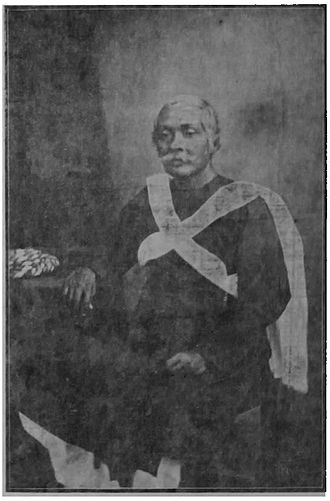
Peary Chand Mittra was the first Bengali member of the TS, and the third Indian admitted, member #135 in the Adyar membership books with an entry date of December 9, 1877.
Blavatsky referred to Mittra in a note recorded in her scrapbook next to a clipping from the London Spiritualist of Jan 25, 1878 of a letter to editor from Peebles, “who is attempting to prove that there are Hindu Spiritualists” to which she added a note commenting “Ask Peary Chand Mittra whether he would accept `materialized’ spooks with sweating and corpse-stinking bodies for his dear `departed ones.’”(26) In The Theosophical Enlightenment, Joscelyn Godwin suggests that Blavatsky and Olcott first made contact with Mittra through Peebles, which is credible in light of their known friendship.(27) Although Mittra is known in the West as an Indian Theosophist and Spiritualist, in his homeland his reputation is as a pivotal figure in the Bengal Renaissance who was acquainted with most of its leaders. In Awakening, a recent survey of the century-long revival of Bengali literary culture, Subrata Dasgupta describes “the ultimate and supreme product” of the Bengal Renaissance as a “cross-cultural mentality, let us call it the Indo- Western mind.”(28) Involvement in the TS was the ultimate expression of Mittra’s Indo-Western mind. Indeed the entire Bengal Renaissance was encouraged by the literary pursuits of Westerners living in Bengal in the late 18th century, and flourished with the mutual interest of Bengalis writing in English and Englishmen learning Bengali.
Mittra features prominently in Dasgupta’s study as “a librarian, businessman, and literary man- at-large, but most famously, under the nom de plume of Tekchand Thakur, the author of Alaler Gharer Dulal…regarded as the first novel in Bengali.”(29) With Radhanath Sikda he “established a monthly Bengali magazine which ran for three years.”(30) A Society for the Acquisition of General Knowledge, founded in 1838, hosted Mittra as a lecturer on a variety of themes, and he was subsequently involved in the creation of the University of Calcutta. Mittra was a founder of the British Indian Association and in 1868 became a member of the Bengal Legislative Council. All these developments illustrate Dasgupta’s thesis that “the Bengal Renaissance’s richest production was the creation of a cross-cultural mentality, a capability to think, perceive, and create in a manner that involved the melding of two or more traditions seemingly unconnected and even contradictory…the `Indo-Western mind’, resulting from a constellation of encounters of all sorts between Bengal and the West…”(31)
The first details about the Brahmo Samaj in Blavatsky’s writings came in an 1878 article about the Arya Samaj: “in October, 1839… Debendra Nath Tagore founded the Tattvabodhoni-Sabha (or Society for the Knowledge of Truth), which lasted for twenty years, and did much to arouse the energies and form the principles of the young church of the Brahmo-Samaj. We now find it with Samajes established in many provinces and cities. At least, we learn that in May 1877, “fifty Samajes have notified their adhesion to the Society and eight of them have appointed their representatives.”(32) The rest of the article was devoted to the Arya Samaj, and for the next four years the TS Founders would pursue alliances with that organization and with the Sinhalese Buddhists. Their travels to northern and western India and Ceylon occupied much of their time and energy in 1879 and 1880. It was only in 1882, the year in which the Arya Samaj and the TS became permanently alienated, that they would visit Bengal and strengthen their ties with the Brahmo Samaj. The first mention of a Bengal Renaissance leader in Blavatsky’s writings in India was found in an American Spiritualist publication, the Banner of Light, where she wrote that “the frequent statements of Dr. Peebles to the effect that this country is full of native Spiritualists are—how shall I say it? a little too hasty, and exaggerated…Dr. Peebles quotes from the letter of an esteemed Hindu gentleman, Mr. Peary Chand Mitra, of Calcutta…We all know that Mr. Mitra is a Spiritualist, but what does it prove?”(33) In an unpublished fragment found in Adyar Archives and published in the Collected Writings as “Theosophy— the Essence of Philosophy,” dated 1879, she wrote: “and here, in the present century, we will find ourselves face to face with, and recognize as Brother Theosophists, such original thinkers as Swami Naratan, Ram Mohun Roy, Brahma charya Bawa, Keshub Chunder Sen, and finally, last, though by far not least on our catalogue— Swami Dayanada Sawaswati, the learned Pandit, eminent Vedic scholar and elocutionist, and the founder of the Aryan Reformation.”34 Although Mittra’s acquaintance with the TS dates to 1877, he took four years to contribute directly to Theosophical literature. In a March 1881 article for the Theosophist, Blavatsky commented “Ever since we came to India friends in Europe and America have been asking us to tell them something about the Brahmo Samaj. We have been promised such an exposition of Brahmoism more than once by Brahmo friends.”(35)
In 1882, Mittra was elected president of the TS branch in Calcutta, and Blavatsky wrote about him as “certainly the most spiritual Theosophist and most theosophic Spiritualist we have ever met.”(36) Answering questions about the suitability of a Spiritualist president of a Theosophical branch, she wrote that “many excellent persons are both, and none need alter his faith.”(37) Emma Hardinge Britten’s Nineteenth Century Miracles (published in 1884 but in a passage apparently written during Mittra’s lifetime) called Mittra a highly esteemed Indian Spiritualist: “Amongst the recent literary productions which bear testimony to the spread of the spiritual faith in India, no writings are more highly esteemed than those of Peary Chand Mittra. Besides a number of excellent magazine articles contributed by this gentleman to the different Spiritual periodicals of England and America, Mr. Mittra has written an interesting brochure entitled `Spiritual Stray Leaves,’ and a still more profound work on `the Soul; it’s [sic] nature and development.”(38)
23 Stainton Moses, “The Early Story of the Theosophical Society,” Light, Vol. XII, No. 602Jul 23, 1892, 356.
24 Letters of H. P. Blavatsky, Vol. 1 (Wheaton: Theosophical Publishing House, 2003), 361.
25 Krishna Singh Arya and P.D. Shastri, Swami Dayananda Sarasvati: A Study of His Life and Work (Delhi: Manohar, 1987), 17-18.
26 H.P. Blavatsky, H.P. Blavatsky Collected Writings, Vol. 1 Second edition. (Wheaton: Theosophical Publishing House, 1977), 282.
27 Joscelyn Godwin, The Theosophical Enlightenment (Albany: SUNY Press, 1994), 327. This book devotes several psges to Brahmoism, far more than other works addressing TS history, but concentrates on the period prior to TS/Brahmo contact.
28 Subrata Dasgupta, Awakening (Noida, U.P.: Random House India, 2011), 3.
29 Ibid., 178.
30 Ibid., 179.
31 Ibid., 431.
32 “The Arya Samaj,” New York Echo, June 2, 1878 in H.P. Blavatsky Collected Writings Vol. I, 381.
33 H.P. Blavatsky, “Echoes rom India, ” Banner of Light, XLVI no 4, October 18, 1879, in H.P. Blavatsky Collected Writings, Vol. II (Wheaton: Theosophical Publishing House, n.d.).
34 H.P. Blavatsky, “Theosophy, the Essence of Philosophy,” H.P. Blavatsky Collected Writings, Vol. II, 209.
35 H.P. Blavatsky, “The Brahmo Samaj,” Theosophist 2:6, March 1881 reprinted in H.P. Blavatsky Collected Writings, Vol. III (Wheaton: Theosophical Publishing House, 1968), 55.
36 H.P. Blavatsky, H.P. Blavatsky Collected Writings, Vol. IV (Adyar: Theosophical Publishing House, 1969), 170.
37 Ibid.
38 Emma Hardinge Britten, Nineteenth Century Miracles (New York: Lovell, 1884), 317.